Ignition

Ignition is the start of flaming or glowing combustion in a material exposed to a heat source.

Every Ignition article of the Injection Molding Resources, newest first, each written from published standards, research and makers’ data.

Meaning

Ignition is the start of flaming or glowing combustion in a material exposed to a heat source. Fire tests for molded parts record whether, and at what temperature or exposure, a specimen ignites, and the standards built on them aim first at preventing ignition and then at containing a fire if it starts.

Electrical Sources

The introduction to IEC 60695-2-12 names overheated metal parts as ignition sources in electrical equipment, for example through a fault current in a wire, an overloaded component or a bad connection. The glow wire tests simulate that source with an electrically heated wire pressed against a specimen. IEC 60695-1-10 and its companion part set the primary aims as preventing ignition caused by an energized component and confining any resulting fire within the product’s enclosure.
Read More

Glow Wire Ignition Temperature

IEC 60695-2-13 rates the temperature at which a material ignites under the glow wire, the GWIT, while IEC 60695-2-12 rates the highest temperature at which it either does not ignite or extinguishes within 30 s. Makrolon 2407 polycarbonate prints a GWIT of 875 °C from 0.75 to 3.0 mm. LATI prints a GWIT of 775 °C at 0.4 to 1.5 mm and 825 °C at 3.0 mm for a halogen-free glass-filled PA66 whose flammability index is 960 °C, so the two numbers differ for the same material.

Ignition in UL 94

The UL 94 vertical classes record ignition of a different kind: whether drips from the specimen ignite a layer of cotton below. V-0 and V-1 forbid it; V-2 allows it. The glow wire flammability index has a similar condition, requiring that drips do not ignite the wrapping tissue under the specimen.

Materials and Products

These are materials tests under laboratory conditions. Their data can be used to preselect materials for the end product test of IEC 60695-2-11, which the end product standard decides whether to require on the part itself.
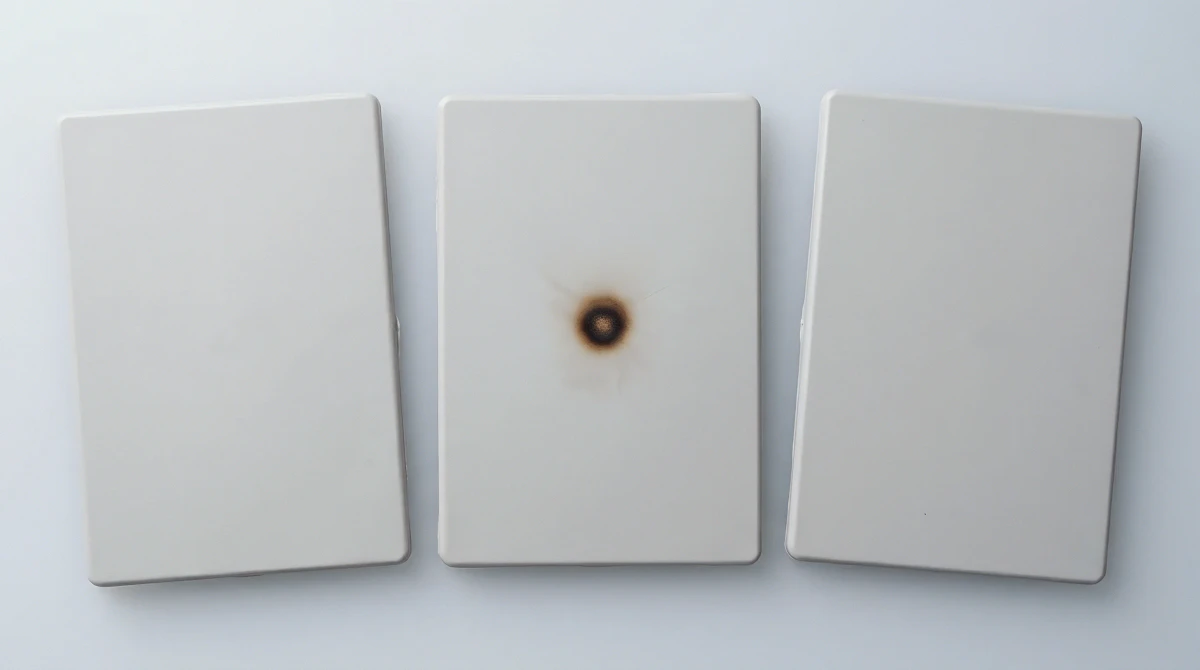
IEC 60695-2-12 Glow Wire Flammability Index for Molded Parts

The glow wire flammability index read for a buyer: what IEC 60695-2-12 measures, how makers print it by thickness, and what a molded part's file can carry from it.

What IEC 60695-2-12 MeasuresThe scope, printed on the IEC webstore and in the 2021 preview, is short. The standard specifies the details of the glow wire test applied to specimens of solid electrical insulating materials, or other solid materials, to determine the glow wire flammability index, GWFI.

UL 94 Flammability Ratings Explained for Molded Plastic Parts

The UL 94 classes read as a buyer needs them: what each test does, how three common resin sheets print a rating, and what a supplier should show.

What UL 94 Measures and What It Is NotUL 94 is a family of small-scale flame tests on strips and plaques of plastic, run under laboratory conditions. UL's own page on combustion tests for plastics groups the classifications into twelve: HB, V-0, V-1 and V-2, 5VA and 5VB, VTM-0, VTM-1 and VTM-2, and HF-1, HF-2 and HBF for foams.

Polycarbonate Injection Molding Properties for Clear and Tough Parts

Polycarbonate read from the maker's sheets for a buyer: what it molds like when dry and hot, how thin walls fill, and what to ask of an aluminum tool.

Makrolon 2407 Properties in Metric and Inch UnitsMakrolon 2407 is a low-viscosity, general-purpose, UV-stabilized, easy-release polycarbonate with a melt volume-flow rate of 19 cm³/10 min at 300 °C and 1.2 kg under ISO 1133. Its ISO short name is ISO 7391-PC,MLR,(,,)-18-9.

Request an Injection Molding Quote

Send the 2D drawing and the 3D file, with the quantity and the stage of the project. An engineer replies within 1 working day.

The quote form, the mutual NDA and the private folder for your files are on Protolis Atelier, with Injection Molding chosen.

Request a Quote