Strain at Break

Strain at break is how far a tensile test bar stretches, as a percent of its length, before it breaks under ISO 527.

Every Strain at Break article of the Injection Molding Resources, newest first, each written from published standards, research and makers’ data.

Meaning

Strain at break is how far a tensile test bar stretches, as a percent of its length, before it breaks under ISO 527. It separates a plastic that yields and keeps stretching from one that snaps. Datasheets print it beside yield strain and tensile strength, measured on a bar pulled at a set speed, 50 mm/min for Makrolon 2407. A snap fit or clip is sized against it and against the yield strain.

Values

Makrolon 2407 polycarbonate reaches 120 percent at break, with yield at 6.0 percent strain and 66 MPa (9,600 psi). Delrin 500P acetal reads a nominal tensile strain at break of 30 percent, with yield at 17 percent and 71 MPa (10,300 psi). Zytel 70G33HS1L glass nylon reads 3.5 percent dry and 5.0 percent conditioned.
Read More

Ductility Gap

Polycarbonate yields, stretches and keeps stretching. Glass-filled nylon does the opposite, breaking at 3.5 percent dry. That low elongation is why DuPont advises against undercuts above 3 percent in glass-reinforced nylon.

Moisture

For nylon, water raises strain at break while it lowers strength. The glass grade’s conditioned column shows 5.0 percent against 3.5 percent dry, with tensile stress at break falling from 200 to 140 MPa. Water makes the part both softer and tougher.

Design Use

A polycarbonate snap fit is sized inside its 6.0 percent yield strain, where the curve stops being elastic. An acetal snap fit keeps its strain well inside the 17 percent yield strain. A repeated assembly is judged on a lower strain that the acetal sheet does not state, and the assembly count is agreed.
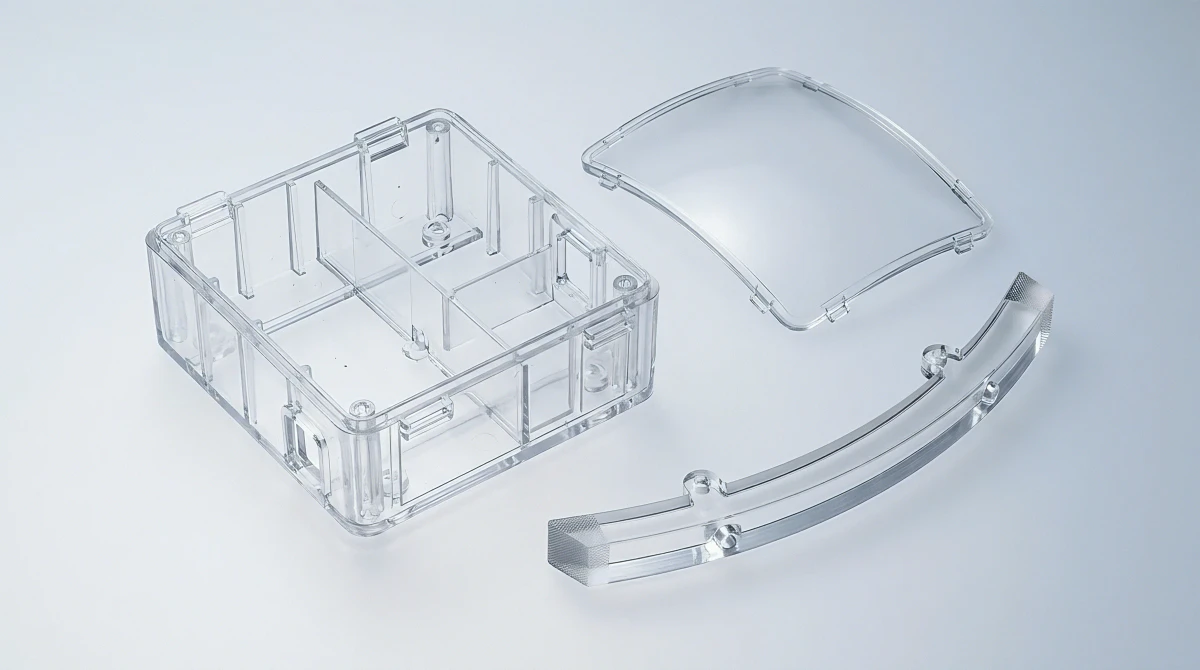
Polycarbonate Injection Molding Properties for Clear and Tough Parts

Polycarbonate read from the maker's sheets for a buyer: what it molds like when dry and hot, how thin walls fill, and what to ask of an aluminum tool.

Makrolon 2407 Properties in Metric and Inch UnitsMakrolon 2407 is a low-viscosity, general-purpose, UV-stabilized, easy-release polycarbonate with a melt volume-flow rate of 19 cm³/10 min at 300 °C and 1.2 kg under ISO 1133. Its ISO short name is ISO 7391-PC,MLR,(,,)-18-9.

Glass-Filled Nylon 66 in Injection Molding and What It Does to an Aluminum Tool

How a glass-reinforced nylon behaves dry and conditioned, in the press and on an aluminum tool, and what its datasheet leaves for the buyer to settle.

Properties of 30 Percent Glass-Filled Nylon 66 Dry and ConditionedPA66 with 30 percent glass is one of the most common reinforced engineering grades, and BASF's Ultramid A3WG6 LT BK, a laser-transparent black grade whose sheet is dated 09/2026, is a clear example of how the family reads. The sheet names the polymer PA66-GF30 and gives its typical values for uncolored product at 23 °C.

Acetal Homopolymer Injection Molding Properties and Gate Rules

Delrin 500P read from the maker's sheet and molding tips: why acetal shrinks and needs a packed gate, how hot the melt may run, and what to check on an aluminum tool.

Delrin 500P Properties in Metric and Inch UnitsDelrin 500P NC010 is a medium-viscosity acetal homopolymer, and Delrin prints its ISO values as the reference beside 500CPE on its own product data sheet. The grade has a melt mass-flow rate of 15 g/10 min at 190 °C and 2.16 kg under ISO 1133.

Request an Injection Molding Quote

Send the 2D drawing and the 3D file, with the quantity and the stage of the project. An engineer replies within 1 working day.

The quote form, the mutual NDA and the private folder for your files are on Protolis Atelier, with Injection Molding chosen.

Request a Quote