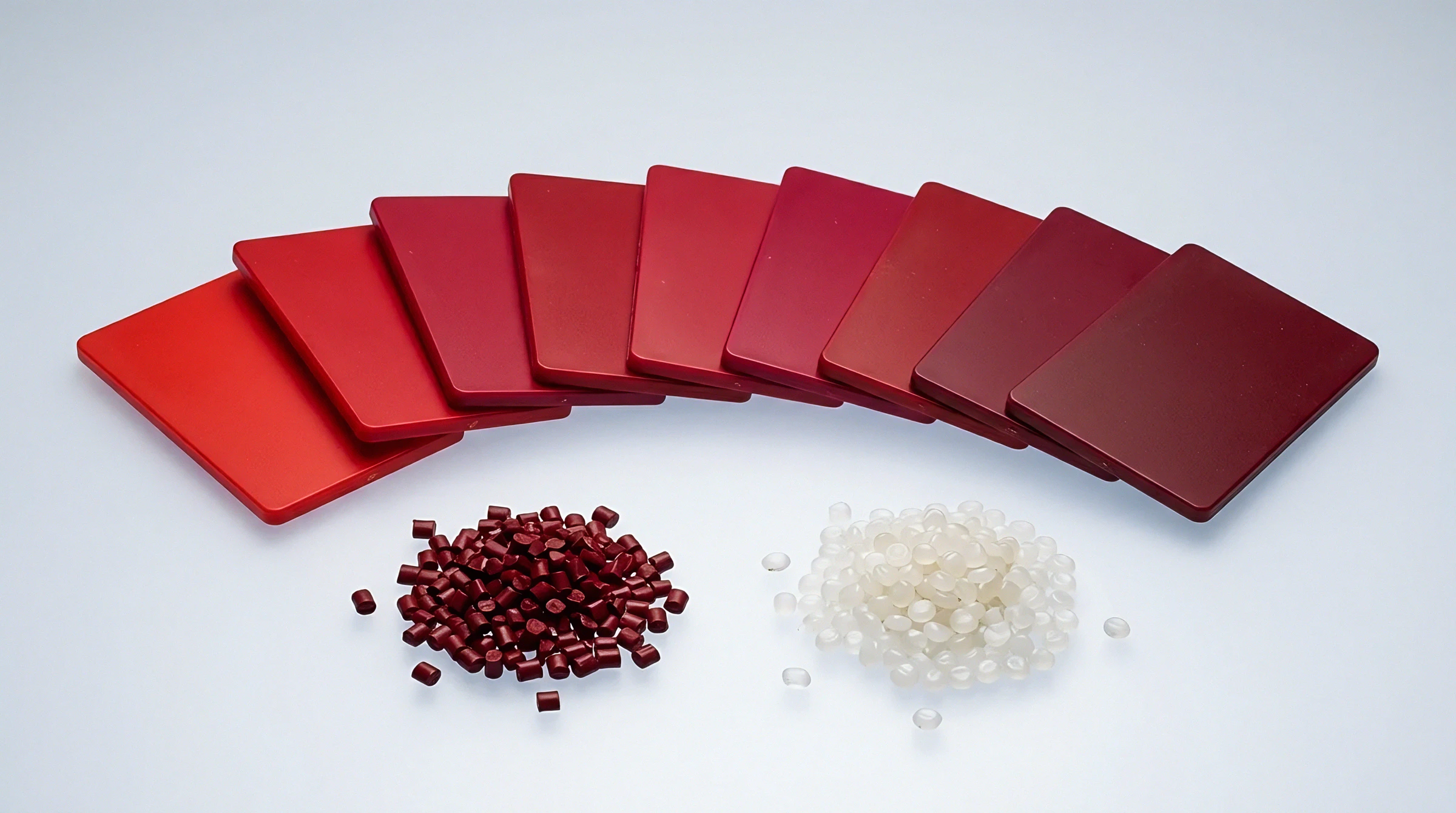
A color masterbatch can generally be formulated and produced in less than a week, Machine Design reported in its article on mastering color, while precolored resin typically takes 4 to 16 weeks. Clariant’s masterbatch division told Canadian Plastics it could color-match in three days and deliver production in five. For a bridge run that has to start before a production tool exists, that difference decides whether the parts come off the press in the right color or in natural.
Masterbatch is concentrated colorant in a carrier, dosed into natural resin at the press. It moves the color decision from the resin supplier to the molding cell, and with it the responsibility for keeping color the same from the first part to the last. This piece covers the forms and let-down ratios makers publish, the lead times, the mixing and plasticizing that turn pellets into even color, the things that shift color within a run, and how color is measured and accepted lot by lot.
How Masterbatch Color Is Held Across a Run
Three things have to stay constant for color to hold. The masterbatch has to be the same formulation at the same let-down ratio, the melt has to distribute it evenly, and the part has to be measured the same way each time. A change in any of them shows as a color difference, often before anything else on the part changes.
Machine Design describes what a masterbatch is: a premeasured mixture of concentrated additives, such as color, stabilizers or lubricants, in a resin carrier. Pellets are mixed with the base resin, called the let-down resin, before or at the press. Canadian Plastics adds the distinction that matters most in the molding cell. Dispersion, breaking pigment into fine particles in the carrier, is the masterbatch maker’s job. Distribution, spreading those particles evenly through the part, is the molder’s.
A masterbatch maker controls dispersion. The molder controls distribution and measurement, and those two decide whether part 5,000 matches part 1.
Masterbatch Forms and Let-Down Ratios
Machine Design’s article sets out the forms and their trade-offs.
| Form | How it is made and added | Characteristics given |
|---|---|---|
| Resin-specific solid | Colorant compounded into the same polymer as the let-down resin, cut into standard or micro pellets | Good all-round choice; may need mixing screws or nozzles |
| Universal solid | Carrier broadly compatible with several let-down resins | High loadings that mix easily; one concentrate can suit several resins of the same base opacity and tone |
| Powder | Pigments and dyes preblended and added directly | No predispersion, so agglomerates can occur; suits dye tinting of transparent resins; dusty |
| Semisolid | Colorant fluxed with wax into prills, pastilles or pellets | Good incorporation; can cause screw slippage; harder cleanup |
| Liquid | Colorant milled with surfactants in a liquid carrier, pumped in | High incorporation; metering equipment is maintenance intensive; best for long runs of standard colors |
The same article gives the range for highly loaded masterbatches: let-down ratios from 50:1 to 200:1, base resin to concentrate. It adds two cautions about carriers. Polyethylene can look attractive as a carrier but tends to migrate to part surfaces, where it may peel or stick to the mold. And a colorant acts like a contaminant in the resin, so particle size, consistency and dispersion all bear on the part’s physical properties.
Ampacet publishes addition rates for its RediBatch line, a highly loaded masterbatch on a universal carrier offered for short runs of specific colors.
| Polymer | Addition rate | Masterbatch per 100 kg (220 lb) of resin |
|---|---|---|
| Polypropylene, polyethylene | 1 % | About 1 kg (2.2 lb) |
| Polycarbonate | 1 % | About 1 kg (2.2 lb) |
| Polyamide (nylon), acetal | 1 % | About 1 kg (2.2 lb) |
| PBT and PET polyester | 1 % | About 1 kg (2.2 lb) |
| GP polystyrene, SAN, opaque acrylics, EVA | 1 % | About 1 kg (2.2 lb) |
| HI polystyrene, polyurethane | 1 to 2 % | About 1 to 2 kg (2.2 to 4.4 lb) |
| ABS, PVC | 1 to 3 % | About 1 to 3 kg (2.2 to 6.6 lb) |
| Thermoplastic alloys and blends | 1 to 3 % | About 1 to 3 kg (2.2 to 6.6 lb) |
| Filled polymers | 1 to 3 % | About 1 to 3 kg (2.2 to 6.6 lb) |
A 1 % addition is a 100:1 let-down, inside Machine Design’s highly loaded range. Clariant’s representative told Canadian Plastics that its work with micropellets was taking ratios below 1 %. Lower ratios ask more of the molder’s dosing and distribution, which is where the next sections come in.
Lead Time for a Color Match
Machine Design describes why masterbatch shortens the path to a colored part. Precolored resin, with its 4 to 16 week lead times, ties up larger inventories and leaves the buyer with obsolete material when color preferences change; masterbatch is mixed with natural resin at the machine. The article cites the automotive industry’s move from precolored materials to masterbatch in the late 1970s, and a business machine maker that switched from precolored resin to masterbatch with natural resin for one of its product lines.
Canadian Plastics adds the turnaround on the supply side. Clariant reported a color match in three days and production in five. Another masterbatch maker described couriering small quantities to processors who need to fine-tune color, and recommended that the coloring system be considered while the part is still on the drawing board, since every round of fine-tuning takes time.
The base resin matters to how quickly a match settles. Trinseo states that its mass-polymerized MAGNUM ABS grades have a consistent white base, less yellow than most competing resins, which takes less pigment for white and light colors and suits coloring by masterbatch. It also points to small lots of different colors as the case masterbatch serves well, since natural resin plus masterbatch replaces a stock of precolored lots.
For a short run, masterbatch turns a color into a lead time of days rather than weeks, provided the match is made in the resin the part will actually be molded in.
Mixing, Dosing and Plasticizing
Even color starts before the press. Ampacet asks that its masterbatch and the polymer be thoroughly premixed, with tumble mixers or colorant metering equipment, to keep color consistent through the run. For resins that need drying, such as ABS and nylon, it advises adding the masterbatch only after drying if the drying temperature exceeds 107 °C (225 °F). It recommends melt temperatures not above 316 °C (600 °F) and lists maximum processing temperatures per product.
The barrel may need adjusting too. Ampacet suggests that the plasticizing capability of the equipment be evaluated, and lists raising the middle zone temperature and cooling the feed zone among the possible adjustments. Canadian Plastics raises the same point from the field: older presses and worn or poorly suited screws may not distribute a very high let-down well, and a slightly richer let-down is often the simplest fix.
BASF’s troubleshooting brochure gives the process causes of colored streaks, which it describes as color differences on the surface from uneven pigment distribution, often at weld lines and behind sharp edges:
- In self-coloring with poor dispersing action, raise back pressure, lower screw speed and raise melt temperature.
- Where the plasticizing unit mixes poorly, use a longer screw, a mixing section or a shallow-flighted screw for gentler, more homogeneous melting.
- Where pigments are damaged by thermal or mechanical load, lower melt temperature, injection speed, screw speed and back pressure.
- Where foreign material collects in dead spots of the barrel or hot runner, clean both thoroughly.
Hot runners add a color change question. DuPont’s Zytel molding guide suggests that where hold-up spots in a hot runner are suspected, the color be changed at the barrel and molding continued for an additional 10 minutes, after which the hot runner and nozzle are taken apart to find where the first color remains. The same test shows how long a color change takes on that tool before parts are in the new color.
What Changes Color Within a Run
Several causes act without any change to the masterbatch. Machine Design lists the resin side: base resins from different makers may look alike but carry trace chemicals such as antistats or antioxidants that react with a dye or pigment, and flame retardants, butadiene impact modifiers, surfactants, catalyst residue, stabilizer packages and regrind can all shift color. It adds three effects of temperature and chemistry:
- Dyes can migrate to the surface and turn dull. In hydrophilic resins such as nylon, water can open paths for that migration.
- Some pigments dissolve in certain resins and behave like dyes, shifting color sharply, for example from orange to yellow.
- Some resin and pigment combinations react, and a melt temperature only 50 °C (90 °F) higher, raised to help fill a glass or mineral filled part, could turn an orange part brown.
Canadian Plastics adds wall thickness and regrind. A technical manager quoted there describes variations in thickness, let-down ratio, resin color and regrind all changing appearance, and notes that in thin parts the same concentrate can look like two different colors at two thicknesses. Regrind from a mixed stream containing titanium dioxide, fed into a color with little or none, makes the target intensity very hard to reach.
The colorant can also change the part. UL Prospector’s article on choosing colorants notes that pigments can weaken properties such as impact resistance, that organic pigments influence crystallization during cooling, particularly in HDPE, and that molding the same part in different colors can give different dimensions. John Bozzelli’s Plastics Technology column on living hinges reports the same effect in polypropylene: different colors change the degree of crystallization, and it is common for one or two colors in a plant to cause hinge problems, so every color is tested against natural.
Measuring Color and Accepting a Lot
Color is accepted on a measurement, and the measurement needs agreed conditions. ASTM D2244, as its public scope describes it, covers calculating color tolerances and small color differences from instrumentally measured coordinates under daylight illumination, for opaque specimens including plastic plaques, expressed in CIE 1976 CIELAB space. It makes several points a buyer can use directly:
- The purchaser and the seller agree the permissible tolerance between specimen and reference and the procedure for calculating it.
- Differences are comparable only within the same color-scale system; no simple factor converts a tolerance from one system to another.
- A single total difference value tells whether a specimen is within tolerance, but production control may also need the three components, which give the direction of the departure.
- Gloss, texture and specimen proximity can change how a measured difference relates to commercial acceptability.
- Where specimens may be metameric, matching in one light and not another, the instrument result is verified visually.
Canadian Plastics gives the practical rule for metamerism: do not agree on a color match under ambient lighting, but use a light box with lamps of the right color temperature, or instruments, so that the molder and the customer see the part under the same light.
| Condition | What to agree | Source of the reason |
|---|---|---|
| Color space and difference equation | One system for standard and samples | ASTM D2244 scope |
| Tolerance | Value and calculation procedure, agreed by buyer and seller | ASTM D2244 scope |
| Illuminant | Daylight for the equations; visual check for metamerism | ASTM D2244; Canadian Plastics |
| Sample temperature | Measured at ambient, or temperature recorded | Plastics Technology, thermochromism |
| Background, for translucent parts | Measured over black and over white | Plastics Technology, translucent plastics |
| Thickness | The part’s own wall, or a plaque of stated thickness | Canadian Plastics; Plastics Technology |
Temperature is the condition most often missed at the press. Plastics Technology’s article on thermochromism reports that colors measured at a typical ejection temperature and again at ambient differed in every color tested, with reds and yellows shifting most, and that all returned to their base readings once cool. Samples are therefore cooled to near ambient before measurement, or measured on an instrument that records their temperature so that pass and fail limits can be set for both.
Translucent parts need more. A second Plastics Technology article explains that measuring over a white background alone cannot separate white pigment from the white behind the sample, so reflectance is measured over both black and white. Light can also escape from the edges of a thick translucent sample, darkening the reading, which is reduced with thinner samples, a large aperture with a small measuring spot such as 25 mm with 8 mm, or a sample cut to fit the instrument’s sphere. The same article stresses that masterbatchers need samples of the exact polymer the molder uses, since resins of the same type absorb and scatter light differently.
Sampling sets how many parts are measured. NIST’s engineering statistics handbook describes acceptance sampling as the middle course between no inspection and 100 % inspection: a sample drawn at random from the lot, and the lot accepted or rejected on what the sample shows. For color, the sample is measured under the agreed conditions against the retained standard.
Color on Flame-Rated and Functional Parts
Color is not neutral on every part. Ampacet states that adding pigment and carrier may affect a UL rating, that the high additive content of flame-retardant resins limits the range of colors it recommends, and that its universal masterbatch is not recommended for UL applications. A flame-rated part is colored with what the resin’s own listing allows, which may mean a precolored grade rather than masterbatch at the press.
Machine Design adds a chemical caution for engineering resins: chlorine and bromine in dyes and pigments can react with amines in the resin, forming an acid that can degrade the material. Ampacet notes that its masterbatches contain no UV stabilizers, so outdoor parts need a tailored additive package, and that hiding power has to be tested in opaque and filled polymers before production.
The working sequence for a colored production run follows from these sources:
- Match the color in the exact resin grade and at the part’s wall thickness, under the agreed light.
- Fix the let-down ratio and the dosing method, and premix or meter it the same way for every lot.
- Set barrel temperatures, back pressure and screw speed for even distribution, and check weld lines and sharp edges for streaks.
- Retain a standard part and measure each lot against it at ambient temperature, by the agreed difference equation and tolerance.
- Keep regrind out of the color unless it is the same color and has been tested.
The same masterbatch lot, the same resin grade and the same measurement conditions carry a color from one lot to the next. In low-volume injection molding for bridge production, the color standard and its measurement record are agreed at the first article, so that every later lot is accepted against the same part.
Sources and Further Reading
- RediBatch Universal Masterbatch Brochure, Ampacet
- Mastering Color, Machine Design
- Flying Colors, Canadian Plastics
- ASTM D2244, Standard Practice for Calculation of Color Tolerances and Color Differences from Instrumentally Measured Color Coordinates, scope, ASTM International
- Choosing Plastic Colorants, UL Prospector
- Digital Color Management for Translucent Plastics, Plastics Technology
- Some (Don’t) Like It Hot, Overcoming Thermochromism Challenges in Plastics Manufacturing, Plastics Technology
- What Is Acceptance Sampling?, NIST/SEMATECH e-Handbook of Statistical Methods, section 6.2.1, NIST
- Injection-Molding Problems in Engineering Thermoplastics, Causes and Solutions, BASF
- Zytel and Minlon Nylon Resins Molding Guide, 2017, DuPont
- MAGNUM ABS Resins Brochure, EMEA, Trinseo
- Injection Molding, How to Mold Living Hinges With No Flexing Required, Plastics Technology