Drying

Drying removes water from resin pellets before molding, in a dehumidified-air or vacuum hopper dryer, to the moisture limit the resin maker sets.

Every Drying article of the Injection Molding Resources, newest first, each written from published standards, research and makers’ data.

Meaning

Drying removes water from resin pellets before molding, in a dehumidified-air or vacuum hopper dryer, to the moisture limit the resin maker sets. It is a quiet step whose faults appear later as splay, brittle parts or a screw that will not turn. Each resin has its own limit, temperature and time. A dryer log is the evidence that the step ran.

Settings

DuPont dries Zytel and Minlon nylon to below 0.2 percent, fresh bags 2 to 4 hours at 80 °C (175 °F). Its dew point sits below -18 °C (about 0 °F). Air flow is 3.0 to 3.7 m³/h for each kg/h of resin processed. Makrolon 2407 polycarbonate is dried at 120 °C (248 °F) for 4 hours to 0.02 percent. Covestro’s conductive grades take 121 °C (250 °F) at a -29 °C (-20 °F) dew point for at least 4 hours.
Read More

Equipment

Air temperature is measured where the air enters the hopper, not at the dryer. DuPont advises against tray ovens that feed the hopper by hand. When drying has to run longer, the temperature is lowered, not raised. Above 105 °C (220 °F) the hopper and lines are insulated. Above 120 °C (250 °F) after-coolers let the desiccant hold more water. A vacuum dryer needs at least 6,000 Pa and about 20 minutes for heating and vacuum.

Record

Hours at temperature, dew point and the date of the filter change make a log a buyer can compare with the maker’s limits. Resin moisture before molding and the dryer dew point sit in a lot’s process record. A supplier that cannot produce a log has a dryer that may not be measuring what it should.
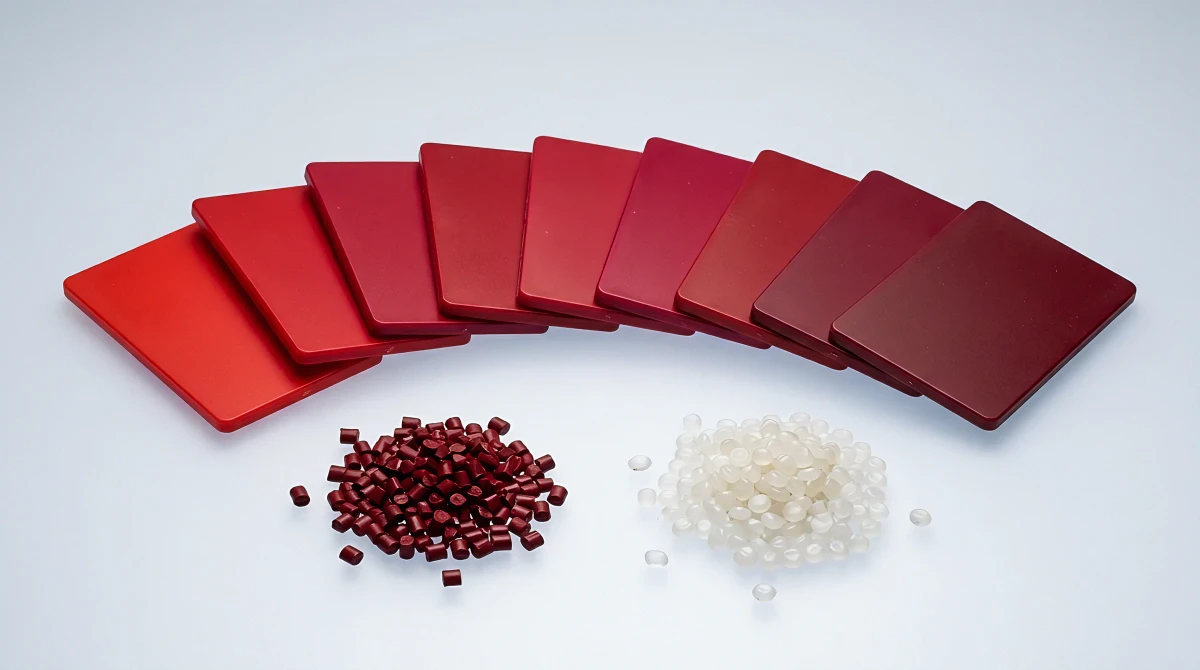
Color Matching Molded Parts With Masterbatch in a Production Run

How masterbatch color is matched, dosed, distributed and measured so that every lot of a molded part matches the standard agreed at the first article.

How Masterbatch Color Is Held Across a RunThree things have to stay constant for color to hold. The masterbatch has to be the same formulation at the same let-down ratio, the melt has to distribute it evenly, and the part has to be measured the same way each time.

Short Shot, Sink and Flash in Injection Molding Traced to Their Cause

Short shots, sinks and flash traced to the melt volume, pressure and steel behind them, with the checks that find the cause before a setting is moved.

What Short Shots, Sink and Flash Have in CommonA short shot is a part the cavity never finished. BASF's troubleshooting brochure for engineering thermoplastics describes it as a part not completely formed, mainly in the areas furthest from the gate or in thin walls.

Polypropylene for Living Hinges in Injection Molding

Polypropylene for living hinges read from design guides and molding columns: grade choice, hinge dimensions, gating across the web, cooling and the tests that prove a hinge.

Why Polypropylene Makes a Living HingeThe MIT design note explains the mechanism. When a partly oriented polypropylene web is cold drawn on its first flex, it stretches by ratios of 2 or 3 to 1, and its tensile strength rises sharply.

ABS and PC/ABS Blends in Injection Molding

ABS and PC/ABS read from the makers' datasheets: drying, processing windows, shrinkage, snap-fit strain, impact and when the blend earns its stricter dryer.

How ABS and PC/ABS Differ in Injection MoldingABS is a terpolymer, and Moldflow's material page describes its structure: a continuous phase of styrene-acrylonitrile with a dispersed phase of polybutadiene rubber. Acrylonitrile brings hardness and chemical and heat resistance, styrene brings processability, gloss and strength, and butadiene brings toughness and impact strength.

How Many Parts One Aluminum Injection Mold Gives

A mold's life is a toolmaker's rating for a stated resin and cavity count, converted into parts per tool and then into tools per quantity.

What Sets the Number of Parts One Aluminum Mold GivesThree things set it, and they act together. One is the alloy and where in the plate the cavity sits.

Drying Resin and Setting Melt Temperature Before the First Injection Molded Part

Pellets are dried to a measured moisture limit, held there to the hopper, and melted inside a window that the resin maker prints.

What Dry Resin and a Correct Melt Temperature ProtectWater in a nylon melt is not a surface problem. DuPont explains that water carried into the melt triggers hydrolysis, which breaks the polymer down, costs toughness and strength, and makes the melt flow more easily.

Polycarbonate Injection Molding Properties for Clear and Tough Parts

Polycarbonate read from the maker's sheets for a buyer: what it molds like when dry and hot, how thin walls fill, and what to ask of an aluminum tool.

Makrolon 2407 Properties in Metric and Inch UnitsMakrolon 2407 is a low-viscosity, general-purpose, UV-stabilized, easy-release polycarbonate with a melt volume-flow rate of 19 cm³/10 min at 300 °C and 1.2 kg under ISO 1133. Its ISO short name is ISO 7391-PC,MLR,(,,)-18-9.

Request an Injection Molding Quote

Send the 2D drawing and the 3D file, with the quantity and the stage of the project. An engineer replies within 1 working day.

The quote form, the mutual NDA and the private folder for your files are on Protolis Atelier, with Injection Molding chosen.

Request a Quote