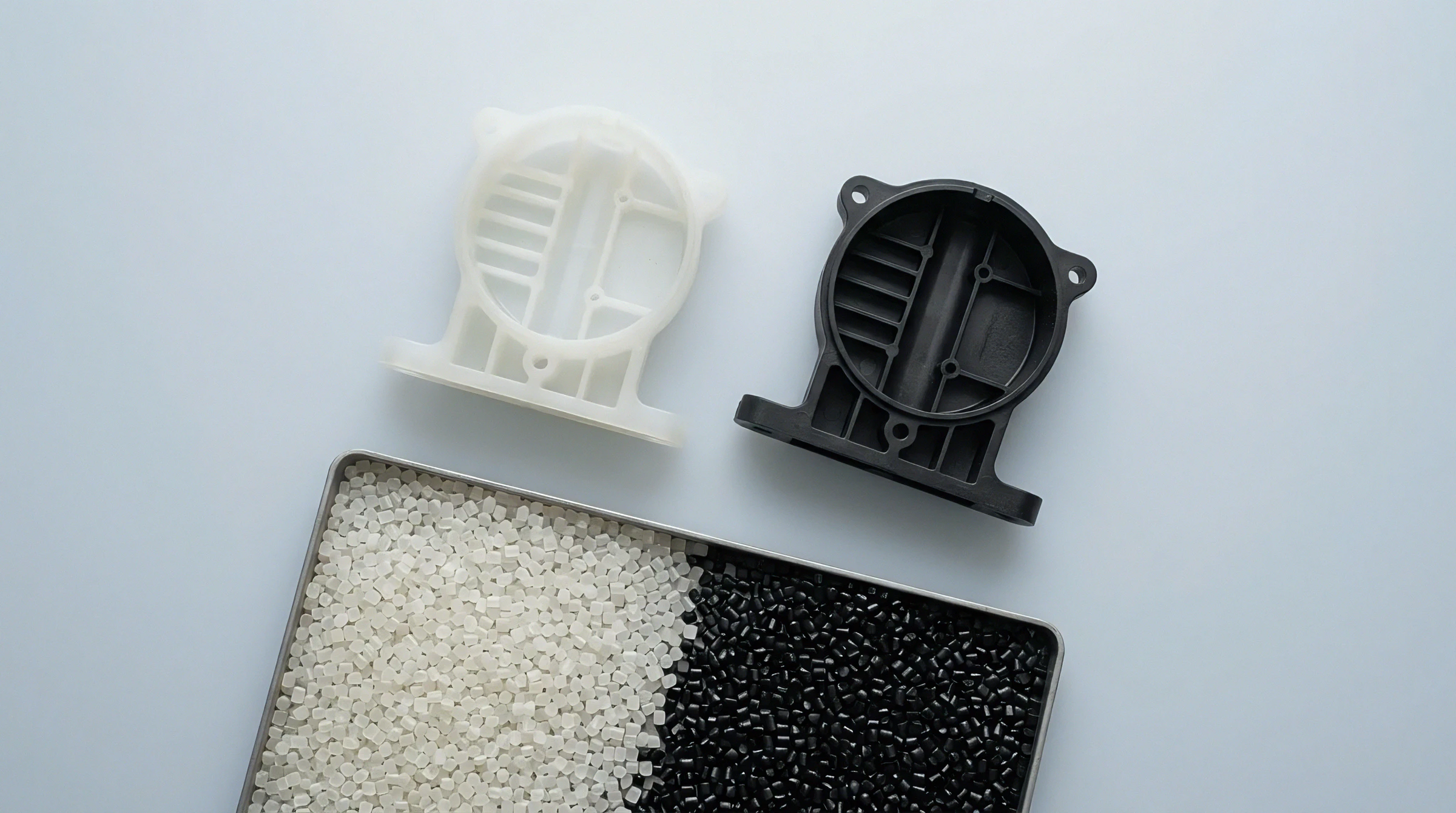
A bag of nylon 66 pellets left open to air at 50 % relative humidity picks up water at a measurable rate every hour, and DuPont’s molding guide sets the ceiling at 0.2 % by weight before the pellets reach the screw. Covestro sets the line for its thermally conductive polycarbonate a decade lower, below 0.02 %. Neither number can be read from the pellets by eye, and both decide whether the first shots show the tool or show the water in the resin.
Drying and melt temperature are the two preparations that happen before the mold closes. They are quiet operations, a hopper dryer humming and a heater band holding a setpoint, so their faults surface later as splay, brittle parts or a screw that will not turn. The sections below walk both in the order a molding cell does them, with the limits that resin makers publish for nylon 66, nylon 6, polycarbonate and acetal.
What Dry Resin and a Correct Melt Temperature Protect
Water in a nylon melt is not a surface problem. DuPont explains that water carried into the melt triggers hydrolysis, which breaks the polymer down, costs toughness and strength, and makes the melt flow more easily. The guide adds that later processing cannot repair resin degraded this way. A part molded from wet pellets keeps the defect for its whole service life.
The effects appear in the process first.
High moisture lowers melt viscosity, so the resin flows more easily and can over-pack the part and the runner. The guide charts melt viscosity against hold-up time for three moisture levels, 0.1, 0.2 and 0.3 %, and the curves separate with time at temperature. Steam forms from excess moisture and shows up as splay marks and internal bubbles. Sticking and flash may appear even when the mechanical properties still pass.
Moisture limits are a property of the resin and of the melt temperature together. Hotter melts and longer cycles lower the moisture a nylon can carry, and DuPont notes a pellet moisture as low as 0.1 % may be needed above 315 °C (600 °F) or with long cycles.
Melt temperature protects the other end of the polymer’s life. Too cold and unmelted pellets travel into the part. If it runs too hot, or too long at a correct temperature, and the resin degrades in the barrel. Each resin has a window and a residence time that goes with it, which later sections set out grade by grade.
Dryer Settings for Nylon and Polycarbonate Pellets
Hopper dryers dry pellets in two ways: desiccant dehumidified air, or vacuum. DuPont recommends hopper dryers sized for the conditions in Table 1. It advises against tray ovens that feed the hopper by hand, since pellets can regain moisture at moderate humidity fast enough to make molding drift over time.
For dehumidified air, the guide names four parameters: air flow, air temperature, dew point and time. Air flow is set per kilogram of resin processed each hour, 3.0 to 3.7 m³/h for each kg/h (0.8 to 1.0 cfm per lb/h). In the guide’s own example is 27 kg/h (60 lb/h), which needs 80 to 100 m³/h (48 to 60 cfm) of dry air. Air temperature is measured where the air enters the hopper, not at the dryer, and prolonged drying at an elevated temperature can discolor pellets or drive off additives.
| Condition | Zytel and Minlon nylon (DuPont) | Makrolon TC polycarbonate (Covestro) |
|---|---|---|
| Moisture content before molding | Below 0.2 wt% | Below 0.02 % |
| Dryer air temperature | 80 °C (175 °F) | 121 °C (250 °F) at hopper inlet |
| Dew point | Below −18 °C (about 0 °F) in the summary, −20 °C (−4 °F) or lower in the drying section | −29 °C (−20 °F) |
| Time | 2 to 4 h for fresh bags | At least 4 h |
| Air flow | 3.0 to 3.7 m³/h per kg/h (0.8 to 1.0 cfm per lb/h) | Not stated in the sheet |
| Other | Vacuum dryers need at least 6,000 Pa and about 20 min for heating and vacuum | Dust and fines may need more frequent filter cleaning |
The dew point in the summary and in the detailed section of DuPont’s guide differ by two degrees, so a buyer comparing a supplier’s dryer log should ask which of the two the supplier works to and that the trend stays below both. Polycarbonate is far less forgiving. A moisture limit ten times tighter than nylon’s, a hotter air stream and a longer minimum time all point to a resin that cannot be dried casually.
When extended drying time is needed, DuPont’s advice is to lower the temperature, not raise it. Above 105 °C (220 °F) the hopper and transfer lines should be well insulated, and above 120 °C (250 °F) dryers need after-coolers so that the desiccant can hold more moisture at a lower return-air temperature. Vacuum dryers work differently: the resin is heated in a chamber and then moved to a position where vacuum draws the moisture out.
Handling Pellets Between the Bag and the Barrel
Dry resin can be wetted again between the dryer and the screw. DuPont’s guide lays out handling rules that cost nothing to follow, and a molder that skips them is a molder whose dryer log means little.
- Store resin dry and close to the operating-area temperature, and let a container stored in a cold place come to molding-area temperature before it is opened, so that moisture does not condense on the pellets.
- Keep a day’s worth of containers or more in the molding area and rotate stock first in, first out, because even laminated barrier bags let a little water through over time.
- Load the hopper with no more than an hour of resin and keep the lid tight.
- Reseal opened bags, for example with heated sealing pliers, instead of leaving unused resin exposed to air.
Virgin DuPont nylon is supplied dry. The guide allows resin to be used straight from sealed containers if moisture is below 0.2 %, but adds that hopper drying should still follow so that pellets in the hopper do not take up moisture from the room. Regrind needs its own care. DuPont’s absorption chart covers regrind from 6 mm (0.25 in) screens, which takes up moisture from humid air, and the guide says regrind from degraded parts is to be thrown away.
Reading Moisture From the Melt and the Part
A moisture meter is the direct check, but the process itself reports moisture in three ways.
- The air shot: wet resin splutters, shows bubbles in the purge and may foam.
- Splay on the part surface.
- A pressure signal, which needs sensors in the mold.
DuPont’s guide describes dynamic pressure drop, which uses two pressure transducers in the cavity. The reading is the pressure at the first sensor at the moment the melt arrives at the second, and it shifts when melt viscosity shifts. A chart for a 2.0 mm wall shows the dynamic pressure drop for resin at 0.08, 0.15 and 0.22 % moisture, so a change in moisture can be read from the pressure signal without stopping the press. The method is described for nylon, but the principle, that a viscosity change is a pressure change, holds for any resin that is sensitive to water.
For acetal, DuPont’s tips sheet uses a simpler test. A foaming test collects a molten purge in water, and a good melt without gas bubbles is denser and sinks when molten, while a degraded melt carries bubbles and floats. The test is made to judge the effect of pigments and colorants, but it works as a quick check on melt quality after a stop.
Splay is a symptom with several causes. Dry the resin first, then check melt temperature and residence time before blaming the tool.
A dryer log is evidence a buyer can ask for. Hours at temperature, dew point and the date of the filter change give a record that can be compared with the numbers in Table 1. A supplier that cannot produce one is a supplier whose dryer may not be measuring what it should.
Melt Temperature Windows for Common Resins
Melt temperature is the temperature of the plastic itself, read with a needle pyrometer from an air shot, not the setpoint of a heater. DuPont asks for periodic melt checks through a run, so that drift out of the limits is caught. For semi-crystalline nylons the cylinder profile is relatively flat, and no zone is set below the polymer’s melting point.
Different resins give very different windows. Table 2 collects what four makers publish.
| Resin | Melt temperature | Mold temperature | Other |
|---|---|---|---|
| Zytel PA66, reinforced | 285 to 305 °C (545 to 580 °F) | 70 to 120 °C (155 to 250 °F), preferred 100 °C (210 °F) | Unreinforced grades take a mold about 30 °C (50 °F) cooler |
| Zytel PA6, reinforced | 260 to 280 °C (500 to 540 °F) | 70 to 120 °C (155 to 250 °F), preferred 100 °C (210 °F) | Flame retardant grades take a melt about 15 °C (25 °F) cooler |
| Delrin acetal, standard grades | 215 ± 5 °C (419 ± 9 °F) | Not stated in the tips sheet | Nozzle or hot runner at 190 °C (374 °F); stable over 30 min |
| Makrolon TC629 polycarbonate | 300 to 350 °C (572 to 662 °F), ideal 310 to 330 °C (590 to 630 °F) | 65 to 100 °C (150 to 212 °F), 65 to 82 °C (150 to 180 °F) to avoid sticking | Thermal conductivity 8 W/mK or more |
Makrolon TC shows why a window is not a single number. Covestro says its thermally conductive grades chill fast, so a hotter melt buys flow length, but too much melt heat warms the mold locally and the part sticks and ejects badly. The right melt temperature balances filling against overheating the tool. For these grades the mold temperature barely changes flow length and still matters for sticking.
Wall thickness enters the same trade. In Covestro’s studies, going from a 1.5 to a 2.0 mm wall lengthens the flow path by 50 to 100 %, depending on conditions and grade, and 1.5 mm is about the thinnest practical nominal wall. A designer who cannot add wall can only add melt temperature, and melt temperature has a ceiling.
An aluminum bridge tool shifts how the melt temperature is read. Aluminum conducts heat 4 to 5 times better than P-20 steel, according to Arconic, so it pulls heat out of the melt faster at a given mold temperature. A resin that fills a long thin wall with a steel-tool setting may need its melt or mold temperature rechecked in the aluminum tool, and the first shots are the time to do it.
Residence Time, Shot Size and the Machine Behind Them
Resin time in the barrel is the bill for melt temperature. DuPont ties the two together in a chart of melt temperature against maximum residence time for Delrin, and gives the stable window of over 30 minutes at 215 ± 5 °C. At higher melt temperatures the allowable time in the barrel falls. The guide for nylons says that processing temperatures have to be matched to hold-up times and that cylinder temperatures should fall as residence time grows, and its cylinder profile chart is drawn for hold-up times of 3, 7 and 11 minutes.
That ties the choice of machine to the choice of part.
A shot that fills a small fraction of the barrel keeps the melt there for several cycles. DuPont warns about selecting a machine size or screw diameter that gives a shot weight too low, particularly with long cycles from insert placing. ARBURG’s data for its ALLROUNDER 370 A, an electric machine with 600 kN (65 US tons) of clamping force and 370 × 370 mm tie bar spacing, list injection units designated 100, 170 and 290 under EUROMAP. At the larger screw of each unit the maximum polystyrene shot is 65, 105 and 172 g (2.3, 3.7 and 6.1 oz), and the smaller screw cuts it to 29, 54 and 97 g (1.0, 1.9 and 3.4 oz). A small part in the 290 unit leaves most of the barrel full of resin that is waiting.
Covestro gives the same warning a number for its polycarbonate: a shot stroke of 2 to 3 screw diameters, to keep heat exposure from degrading the base resin. Long residence leaves residue on the screw flights and check ring, and the sheet pictures those parts after the resin sat for roughly an hour at molding temperature. The screw can seize and the nozzle clog, and then the screw has to be pulled and cleaned.
| Topic | Zytel and Minlon (DuPont) | Delrin (DuPont) | Makrolon TC (Covestro) |
|---|---|---|---|
| Back pressure | Low to none, 0.3 MPa (50 psi) | Not stated in the tips sheet | 5.5 to 7 MPa (800 to 1,000 psi) |
| Screw speed | Retraction time shorter than cooling | Not stated in the tips sheet | 70 to 100 rpm |
| Residence limit | Match temperature to hold-up time | Over 30 min at 215 ± 5 °C | Shot length 2 to 3 times screw diameter |
| Regrind | Discard if from degraded parts | Not stated in the tips sheet | Up to 20 % with little effect on conductivity |
Back Pressure, Screw Speed and Glass Fiber
The screw does as much work on the melt as the heaters. Back pressure and screw speed set that shear heat, and the two makers in Table 3 disagree on how much of it to use because their resins differ. For nylon, DuPont recommends low or no back pressure, near 0.3 MPa (50 psi), which may give better melt quality and shot-to-shot uniformity. Higher back pressure lengthens recovery and, in glass-reinforced resins, breaks fiber.
Fiber length is a measurable cost. DuPont charts the average glass fiber length and tensile strength, flexural modulus and impact strength for reinforced nylon 66 against rear zone temperature, with the retained property percentage falling as the rear zone is set cooler. For glass-reinforced nylon 66 the guide proposes a rear zone of at least 290 °C. A low rear zone raises torque and retraction time while shortening fibers, and the largest loss is in impact properties.
Covestro asks for more back pressure on its polycarbonate, 5.5 to 7 MPa (800 to 1,000 psi), since too little gives up useful shear heating in the barrel, and its data show back pressure and screw speed hardly touch the thermal performance of the finished part. Neither maker is wrong. The right back pressure belongs to the resin, and a setter who carries one setting from nylon to polycarbonate is making a mistake.
Regrind, Color Changes and Purging
Regrind returns runner and sprue to the cycle, and it is the quiet way to lose moisture control or melt quality. Covestro’s studies find that regrind at up to 20 % leaves the thermal conductivity of its TC grades almost unchanged, and the lower viscosity of reprocessed material can even trim the pressure needed. DuPont’s data for nylon regrind show faster moisture pickup, so regrind belongs in the same dryer as virgin pellets.
Colorants alter melt behavior as well. DuPont names a few masterbatch pigments and additives that degrade Delrin in the melt, and a melt that foams soon leaves deposit on the mold and the screw, which later shows up as black specks. It also bars acetal from any contact with halogenated polymers such as PVC and from flame retardant resins, because the acid gas they release attacks it.
The nozzle explains why a color change takes many shots: a skin of melt clings to the inside wall of the nozzle or hot runner and does not move, so the old color drags out slowly. Purging between resins follows DuPont’s choice of polystyrene, cast acrylic or high density polyethylene, and Covestro advises a purge before production because its viscous TC grades can loosen earlier deposits. Both makers finish with air shots.
For a buyer, the point of all this is traceability. Ask which dryer and which hours of drying stand behind each lot, whether regrind is allowed on the part and at what share, and how the melt temperature was measured at the start of the run. The answers separate a molder that controls the melt from one that only sets the heaters. A supplier of low-volume injection molding should be able to hand over those records with the first samples, and they are part of what a bridge production run depends on.
Sources and Further Reading
- DuPont, Zytel and Minlon nylon resins molding guide (GNE-A11218)
- DuPont, Molding tips to optimize production of components made with Delrin acetal homopolymer, Delrin Technical Guide
- Covestro, Processing information for Makrolon TC polycarbonate grades, COV-202, August 2022
- ARBURG, ALLROUNDER 370 A technical data, TD 526447 (metric edition)
- Arconic, QC-10 mold material, hot runner integration technical fact sheet