Back Pressure

Back pressure is the pressure the screw works against as it retracts to meter the next shot, setting the shear heat the melt receives.

Every Back Pressure article of the Injection Molding Resources, newest first, each written from published standards, research and makers’ data.

Meaning

Back pressure is the pressure the screw works against as it retracts to meter the next shot, setting the shear heat the melt receives. It is a process setting with a large effect on recovery time and melt quality. Resin makers disagree on it because their resins differ. A setter carrying one value from nylon to polycarbonate makes a mistake.

Typical Range

DuPont recommends low or no back pressure for nylon, near 0.3 MPa (50 psi). Covestro’s Makrolon 2407 sheet gives 100 to 200 bar (1,450 to 2,900 psi). Its thermally conductive grades take 5.5 to 7 MPa (800 to 1,000 psi).
Read More

Effect on Nylon

Low back pressure may give better melt quality and shot-to-shot uniformity in nylon. Higher back pressure lengthens recovery. In glass-reinforced grades it also breaks fiber, and fiber length is a measurable loss of properties.

Glass Fiber

The Zytel 70G33HS1L molding window lists back pressure of about 0.3 MPa or none. DuPont’s guide warns that high screw speeds break fibers in glass-reinforced resins and cost mechanical properties. That is why the sheet caps screw speed and why back pressure sits low for glass nylon.

Effect on Polycarbonate

Covestro asks for more back pressure, since too little gives up useful shear heating in the barrel. Its data show back pressure and screw speed hardly touch the thermal performance of the finished conductive part.

Cycle Role

Recovery runs while the part cools. DuPont asks for screw settings that keep retraction shorter than the cooling phase. Recovery then adds nothing to the cycle. The cycle table puts recovery under screw speed and back pressure.

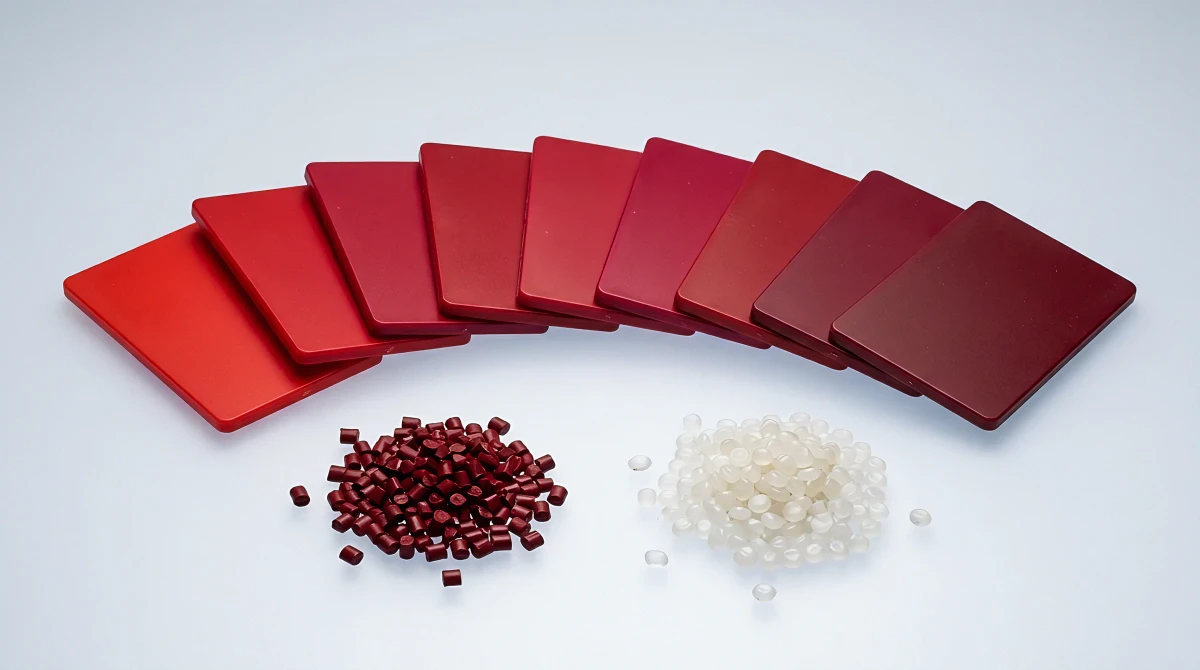
Color Matching Molded Parts With Masterbatch in a Production Run

How masterbatch color is matched, dosed, distributed and measured so that every lot of a molded part matches the standard agreed at the first article.

How Masterbatch Color Is Held Across a RunThree things have to stay constant for color to hold. The masterbatch has to be the same formulation at the same let-down ratio, the melt has to distribute it evenly, and the part has to be measured the same way each time.
Polypropylene for Living Hinges in Injection Molding

Polypropylene for living hinges read from design guides and molding columns: grade choice, hinge dimensions, gating across the web, cooling and the tests that prove a hinge.

Why Polypropylene Makes a Living HingeThe MIT design note explains the mechanism. When a partly oriented polypropylene web is cold drawn on its first flex, it stretches by ratios of 2 or 3 to 1, and its tensile strength rises sharply.

ABS and PC/ABS Blends in Injection Molding

ABS and PC/ABS read from the makers' datasheets: drying, processing windows, shrinkage, snap-fit strain, impact and when the blend earns its stricter dryer.

How ABS and PC/ABS Differ in Injection MoldingABS is a terpolymer, and Moldflow's material page describes its structure: a continuous phase of styrene-acrylonitrile with a dispersed phase of polybutadiene rubber. Acrylonitrile brings hardness and chemical and heat resistance, styrene brings processability, gloss and strength, and butadiene brings toughness and impact strength.

Cycle Time and Parts per Hour in a Bridge Injection Molding Run

A cycle is the sum of fill, hold, cooling and press motions, and a supplier's number is only as good as the pack and cooling times behind it.

What Sets Cycle Time and Parts per HourA molding cycle is a loop of seven moves: the mold closes, the cavity fills, the pack and hold phase runs, the part cools, the mold opens, the part is ejected, and the screw recovers for the next shot. Recovery runs while the part cools, which is why DuPont's nylon guide asks for screw speeds adjusted so that screw retraction time is shorter than the cooling phase.

Drying Resin and Setting Melt Temperature Before the First Injection Molded Part

Pellets are dried to a measured moisture limit, held there to the hopper, and melted inside a window that the resin maker prints.

What Dry Resin and a Correct Melt Temperature ProtectWater in a nylon melt is not a surface problem. DuPont explains that water carried into the melt triggers hydrolysis, which breaks the polymer down, costs toughness and strength, and makes the melt flow more easily.

Polycarbonate Injection Molding Properties for Clear and Tough Parts

Polycarbonate read from the maker's sheets for a buyer: what it molds like when dry and hot, how thin walls fill, and what to ask of an aluminum tool.

Makrolon 2407 Properties in Metric and Inch UnitsMakrolon 2407 is a low-viscosity, general-purpose, UV-stabilized, easy-release polycarbonate with a melt volume-flow rate of 19 cm³/10 min at 300 °C and 1.2 kg under ISO 1133. Its ISO short name is ISO 7391-PC,MLR,(,,)-18-9.

Request an Injection Molding Quote

Send the 2D drawing and the 3D file, with the quantity and the stage of the project. An engineer replies within 1 working day.

The quote form, the mutual NDA and the private folder for your files are on Protolis Atelier, with Injection Molding chosen.

Request a Quote