Datasheet

A datasheet is the resin maker's printed record of a grade's nominal properties, test methods and processing window.

Every Datasheet article of the Injection Molding Resources, newest first, each written from published standards, research and makers’ data.

Meaning

A datasheet is the resin maker’s printed record of a grade’s nominal properties, test methods and processing window. Its values come from molded test specimens under named ISO methods. Covestro states that its values are typical, not guaranteed. A buyer reads it as the starting point of a part’s numbers, never as the part.

Contents

A plastics datasheet groups mechanical, thermal, flammability and processing rows, each with its test standard. Delrin 500P prints tensile modulus under ISO 527-2, Charpy impact under ISO 179 and molding shrinkage under ISO 294-4. Makrolon 2407 adds optical rows, light transmittance and haze, for clear parts. Zytel 70G33HS1L prints two columns, dry as molded and conditioned. The processing rows give drying, melt and mold temperature, hold pressure and hold time per millimeter of wall.
Read More

Test Conditions

Every value belongs to the specimen and the conditions behind it. Makrolon 2407 specimens are molded at a 280 °C melt, an 80 °C mold and 200 mm/s. Its own production advice is a 300 °C melt and a 70 to 110 °C mold. Shrinkage is measured on a 60 by 60 by 2 mm plaque, and no real part looks like it. A part molded at the conditions that fill it differs from the bar by an amount the sheet does not quantify.

Dry and Conditioned

A nylon sheet that prints two columns is describing two parts. Zytel 70G33HS1L reads 11,000 MPa (1.60 million psi) tensile modulus dry and 8,000 MPa (1.16 million psi) conditioned. That gap is 27 percent. Strength falls with water while strain at break and impact rise. A drawing that quotes only the dry column quotes a part that no longer exists by assembly.

Time and Range Rows

A sheet can print time as well as strength. Delrin 500P lists a tensile creep modulus of 2,800 MPa after 1 hour and 1,600 MPa after 1,000 hours. Makrolon 2407 lists 2,200 MPa and 1,900 MPa at the same points. A part under constant load is designed on the long-term figure. Heat deflection is also reported on an unannealed bar, so a part with molded-in stress can soften sooner. Covestro prints its mechanical rows at 23 °C and 50 percent relative humidity, which is a state, not a part in service. Some sheets print more than one value for a property, and that is information. The Zytel sheet gives three expansion rows by temperature range and two by direction. Its coefficient across the flow rises from 6.5E-5 per °C below 23 °C to 1.4E-4 per °C between 55 and 160 °C. A single figure for a plastic is a convenience, and the row for the real range replaces it.

Open Items

A datasheet reports test bars, and a part is not a bar. The glass nylon sheet leaves the part’s own shrinkage, its conditioned dimensions and its fiber orientation open. It prints no flame class above HB and no tool wear by shot count. The acetal sheet leaves homopolymer against copolymer, color, annealing and wall effects to the order. Neither the acetal sheet nor the glass nylon sheet quantifies moisture swell.

Edition and Order Use

Datasheets are revised. The UL Prospector copies of the DuPont sheets read in these resources are dated 2018 and 2019. The Makrolon 2407 sheet is the ISO edition of 30 November 2017. A first-article report records the datasheet revision with the resin lot. The Zytel and Delrin sheets print a UL Yellow Card file number, which is how a flame rating is checked. A sheet that prints a rating without a file reference gives a buyer nothing to verify. The grade is named in full, suffix included, because a rating or a value belongs to that composition. The shrinkage on the sheet is the toolmaker’s first estimate of the allowance. The first samples then give the number the cavity is corrected to. A use the sheet’s own disclaimer excludes, such as medical, food-contact or cosmetic parts for Makrolon 2407, goes to the maker before the order.
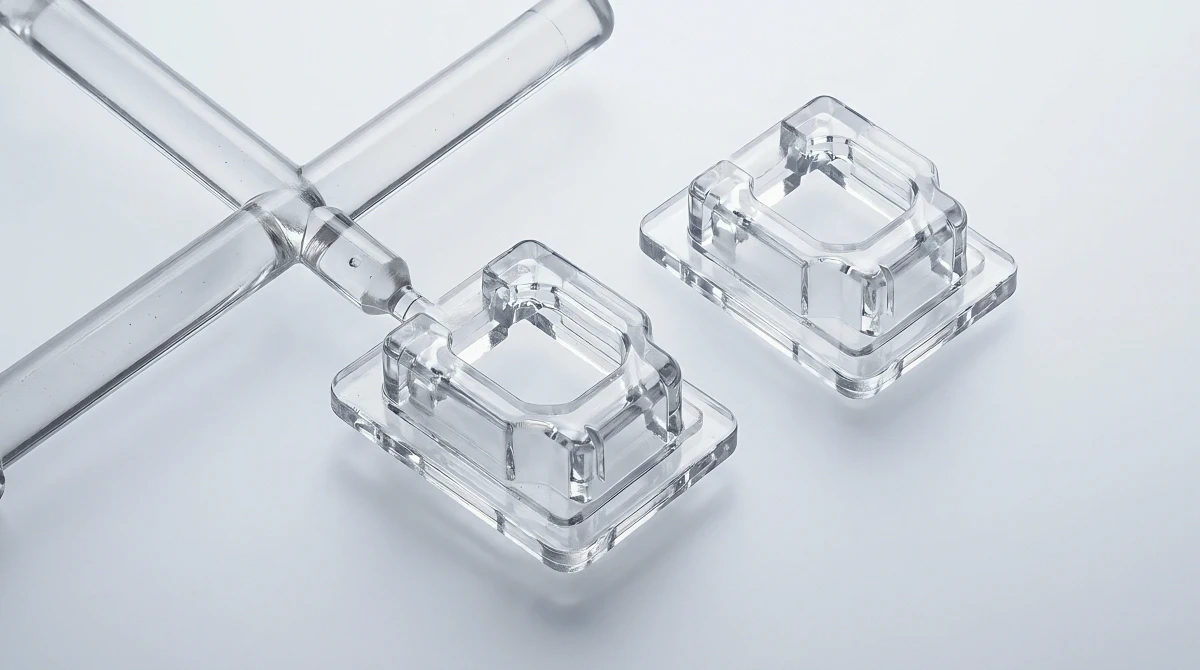
Gate Location and Gate Freeze in Injection Molding

Where a gate goes, how big it is and how long it stays open, with the weight study that sets hold time from the gate itself.

How Gate Location and Gate Freeze Shape a Molded PartAutodesk's Moldflow design rules open with the claim that gate position strongly affects material orientation and warpage, and that changing the gate is sometimes the only way to control orientation. Every gate injects under the same pressure, and the aim of gating is to avoid overpacking some paths while others are still filling, because unequal packing gives unequal shrinkage.

IEC 60695-2-12 Glow Wire Flammability Index for Molded Parts

The glow wire flammability index read for a buyer: what IEC 60695-2-12 measures, how makers print it by thickness, and what a molded part's file can carry from it.

What IEC 60695-2-12 MeasuresThe scope, printed on the IEC webstore and in the 2021 preview, is short. The standard specifies the details of the glow wire test applied to specimens of solid electrical insulating materials, or other solid materials, to determine the glow wire flammability index, GWFI.

Polypropylene for Living Hinges in Injection Molding

Polypropylene for living hinges read from design guides and molding columns: grade choice, hinge dimensions, gating across the web, cooling and the tests that prove a hinge.

Why Polypropylene Makes a Living HingeThe MIT design note explains the mechanism. When a partly oriented polypropylene web is cold drawn on its first flex, it stretches by ratios of 2 or 3 to 1, and its tensile strength rises sharply.

ABS and PC/ABS Blends in Injection Molding

ABS and PC/ABS read from the makers' datasheets: drying, processing windows, shrinkage, snap-fit strain, impact and when the blend earns its stricter dryer.

How ABS and PC/ABS Differ in Injection MoldingABS is a terpolymer, and Moldflow's material page describes its structure: a continuous phase of styrene-acrylonitrile with a dispersed phase of polybutadiene rubber. Acrylonitrile brings hardness and chemical and heat resistance, styrene brings processability, gloss and strength, and butadiene brings toughness and impact strength.

How Temperature Changes the Size of a Molded Plastic Part at the Gauge

How coefficients of expansion turn a few degrees of gauge temperature into hundredths of a millimeter, by resin and direction, and what a drawing should state.

Linear Thermal Expansion of Polycarbonate, Glass-Filled Nylon and AcetalLinear thermal expansion is reported on datasheets as a coefficient, the length change per unit length per degree. The three makers print it by the ISO or TMA method, and they differ in how finely they split it.

Injection Molding Shrinkage Along and Across the Flow by Material

Molding shrinkage read by direction and condition for three resins, with the process settings that move it and the way a first sample turns it into a cavity allowance.

Shrinkage of Polycarbonate, Glass-Filled Nylon 66 and Acetal Along and Across the FlowISO 294-4:2018 sets out the method for measuring mold shrinkage and post-mold shrinkage of injection molded thermoplastic test specimens, parallel and normal to the direction of melt flow. Resin makers print the result in two lines, one per direction.

UL 94 Flammability Ratings Explained for Molded Plastic Parts

The UL 94 classes read as a buyer needs them: what each test does, how three common resin sheets print a rating, and what a supplier should show.

What UL 94 Measures and What It Is NotUL 94 is a family of small-scale flame tests on strips and plaques of plastic, run under laboratory conditions. UL's own page on combustion tests for plastics groups the classifications into twelve: HB, V-0, V-1 and V-2, 5VA and 5VB, VTM-0, VTM-1 and VTM-2, and HF-1, HF-2 and HBF for foams.

ISO 20457 Tolerances for Plastic Molded Parts Read for the Buyer

How ISO 20457 is worded for plastic molded parts, what a supplier signs when a drawing cites it, and which items stay outside it for the order to settle.

What ISO 20457 Covers for Injection Molded PartsAccording to the abstract published by the Swedish Institute for Standards (SIS), ISO 20457 specifies possible manufacturing tolerances for plastic moulded parts, and it covers all integral features with general tolerances, using a surface profile tolerance within a specified datum system. It applies to injection moulding, injection compression moulding, transfer moulding, compression moulding and rotational moulding of non-porous parts in thermoplastics, thermoplastic elastomers and thermosets.

Polycarbonate Injection Molding Properties for Clear and Tough Parts

Polycarbonate read from the maker's sheets for a buyer: what it molds like when dry and hot, how thin walls fill, and what to ask of an aluminum tool.

Makrolon 2407 Properties in Metric and Inch UnitsMakrolon 2407 is a low-viscosity, general-purpose, UV-stabilized, easy-release polycarbonate with a melt volume-flow rate of 19 cm³/10 min at 300 °C and 1.2 kg under ISO 1133. Its ISO short name is ISO 7391-PC,MLR,(,,)-18-9.

Glass-Filled Nylon 66 in Injection Molding and What It Does to an Aluminum Tool

How a glass-reinforced nylon behaves dry and conditioned, in the press and on an aluminum tool, and what its datasheet leaves for the buyer to settle.

Properties of 30 Percent Glass-Filled Nylon 66 Dry and ConditionedPA66 with 30 percent glass is one of the most common reinforced engineering grades, and BASF's Ultramid A3WG6 LT BK, a laser-transparent black grade whose sheet is dated 09/2026, is a clear example of how the family reads. The sheet names the polymer PA66-GF30 and gives its typical values for uncolored product at 23 °C.

Acetal Homopolymer Injection Molding Properties and Gate Rules

Delrin 500P read from the maker's sheet and molding tips: why acetal shrinks and needs a packed gate, how hot the melt may run, and what to check on an aluminum tool.

Delrin 500P Properties in Metric and Inch UnitsDelrin 500P NC010 is a medium-viscosity acetal homopolymer, and Delrin prints its ISO values as the reference beside 500CPE on its own product data sheet. The grade has a melt mass-flow rate of 15 g/10 min at 190 °C and 2.16 kg under ISO 1133.

Request an Injection Molding Quote

Send the 2D drawing and the 3D file, with the quantity and the stage of the project. An engineer replies within 1 working day.

The quote form, the mutual NDA and the private folder for your files are on Protolis Atelier, with Injection Molding chosen.

Request a Quote