A strip of plastic 12.7 mm wide and 127 mm long (0.5 by 5 in), held upright in a clamp, is touched twice for 10 seconds by a 20 mm blue flame fed by a 50 W burner. If the second burn plus glow stops within 30 seconds and no flaming drip lights a pad of cotton below, the plastic can be called V-0 on that thickness. The whole rating comes from that small ritual, repeated on five strips, and it tells a buyer less than the three characters suggest.
UL 94 is the flammability standard that appears on most plastics datasheets sold for appliance housings, connectors, enclosures and covers. The sections below read what it covers, what the classes require, how the sheets of three common injection molding resins print their ratings, and which questions belong on a purchase for a molded part.
What UL 94 Measures and What It Is Not
UL 94 is a family of small-scale flame tests on strips and plaques of plastic, run under laboratory conditions. UL’s own page on combustion tests for plastics groups the classifications into twelve: HB, V-0, V-1 and V-2, 5VA and 5VB, VTM-0, VTM-1 and VTM-2, and HF-1, HF-2 and HBF for foams. The tests share a premise. A small flame touches a specimen, the flame is removed, and the test records how long the specimen keeps burning, whether it drips and whether the drip ignites cotton.
Three limits keep the rating honest. First, it is a rating of a material at a thickness, not of a finished part, and the thickness is part of the label. Second, it measures reaction to a small flame, not heat release or smoke or the behavior of an assembled product in a fire. Third, it sits beside other fire standards on a sheet, such as the glow wire tests of IEC 60695-2-12, the oxygen index of ISO 4589-2 and the burning rate of ISO 3795 for vehicle interiors, and none of them replaces another.
UL’s page lists IEC and DIN counterparts for the HB, V and 5V methods, the DIN EN 60695-11-10 methods A and B and DIN EN 60695-11-20, available on request. A drawing that says only “flame retardant” asks for none of them, and a drawing that says “UL 94 V-0 at 1.5 mm” asks for one.
A UL 94 class is a statement about one material at one thickness under a small flame. It says nothing about a part of a different wall or a flame of a different size.
The Classes and the Molded Wall
UL 94 sorts solid plastics into six classes, from HB, a slow horizontal burn, through V-2, V-1 and V-0 in the vertical test, to 5VB and 5VA under a flame about five times larger, and molded parts almost always belong to that group.
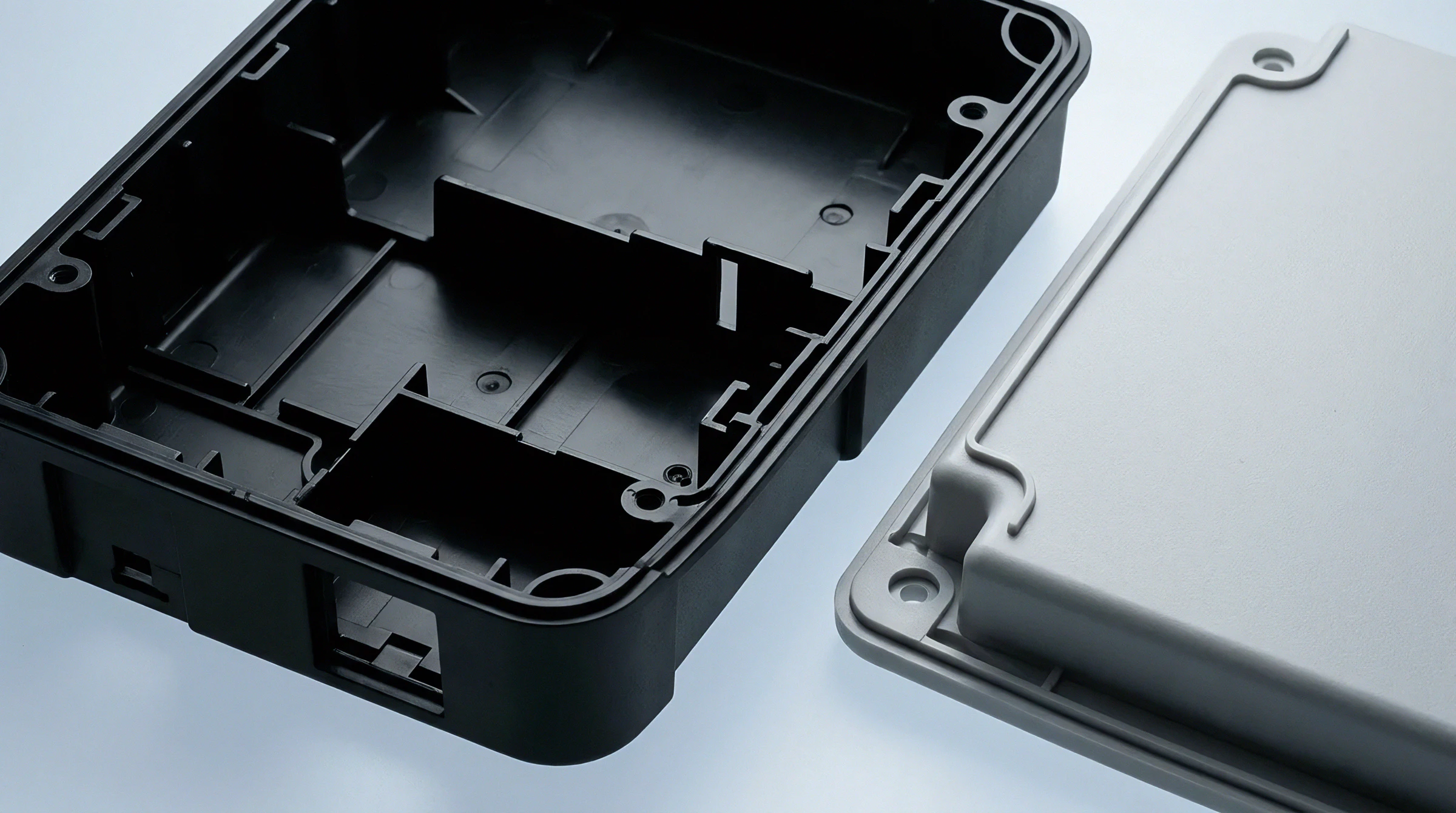
Molding is the process closest to the test, which makes the differences easy to overlook. The rating is printed for stated thicknesses, while a molded part’s walls are set by its design, so the thinnest wall of the part is compared with the thinnest thickness the listing covers, as the section on walls below sets out. The grade’s full name, its colorant and any regrind belong to the composition behind the rating, and a molder who changes one of them is no longer molding the material that was tested.
The 5V classes come up when a molded enclosure faces a larger ignition source. Resin makers print those ratings only for grades developed for them, so a 5VA requirement narrows the choice of resin before any tool is cut, and the gate and wall design then follow the grade that carries it.
The tool itself does not change the class. A bridge tool in aluminum and a production tool in steel mold the same grade, and the rating travels from the first to the second as long as the grade, its color and the thinnest wall travel with it. What breaks the chain is a change made for the second tool: a cheaper grade, a different colorant or a thinner wall to save cycle time. Each of those is a change to the composition or the geometry the rating describes, and the paperwork for the flame requirement starts again with the new combination. Writing the grade, the color and the minimum wall on the drawing keeps the bridge parts and the production parts under the same evidence.
Conditioning and what it does to a result
UL’s page lists the conditioning that comes before the tests. HB specimens are conditioned for 48 hours at 23 °C. Specimens for the V, 5V, VTM and HBF tests are conditioned for two days at 23 °C and also for seven days at 70 °C in a hot-air oven, according to the same page. The implication for a buyer is that the test includes an aging step, so the printed rating is not a reading on a freshly molded strip.
How Two Common Molding Resins Print Their Ratings
The clearest way to see how UL 94 reads on real data is to put two makers’ figures side by side: Covestro’s Makrolon 2407 polycarbonate and Delrin 500P acetal, as Delrin’s Design Guide Module III prints it.
| Entry | Makrolon 2407 | Delrin 500P NC010 |
|---|---|---|
| UL 94 rating at the thinnest listed wall | V-2 at 0.75 mm (0.030 in) | HB at 0.75 mm (0.030 in) |
| UL 94 rating at a heavier wall | HB at 2.7 mm (0.106 in) | HB at 1.5 mm (0.059 in) |
| Oxygen index, ISO 4589 | 27 % | 21.2 % |
| Glow wire flammability index, IEC 60695-2-12 | 850 °C at 0.75 mm, 875 °C at 1.5 mm, 930 °C at 3.0 mm | not printed |
| Comparative tracking index | not compared here | 600 |
Reading across, both resins are in the lowest classes of UL 94 at the walls listed, and a buyer who needs V-0 has to name a flame-retardant grade of whichever resin is chosen. Polycarbonate stands apart in the table because it earns V-2 in the thin wall. It also shows the point about thickness most plainly. The same resin is V-2 at 0.75 mm and HB at 2.7 mm, so a rating can fall as the wall rises, because the test strip that passes at one thickness need not pass at another.
Polycarbonate’s sheet marks the UL rows with the words UL recognition, and a UL file number for the grade is the other way a rating is checked. A sheet that prints a rating without a recognition or file reference gives a buyer nothing to verify, so the buyer asks the resin maker for one.
What a Supplier Signs for a Flammability Requirement
A supplier of molded parts does not test the resin. The resin maker holds the UL listing, and the molder buys a grade that carries it. That makes the chain of paper short, and each link has a question.
- The grade is named in full on the order, including the heat-stabilized or flame-retardant suffix, because the rating belongs to that composition. Delrin 500P is HB at 0.75 and 1.5 mm, while a flame-retardant grade is a different grade with a different sheet.
- The thickness is named for the wall of the part, and the wall is compared with the thinnest thickness the listing covers. Where the part is thinner than the listed minimum, the printed rating is not evidence for it.
- The color is named, and the resin maker is asked whether the listing covers that pigment.
- The listing is shown. A UL Yellow Card number or an online listing entry is checked against the order.
- The resin lot and any regrind percentage are recorded, since a rating describes the resin as listed.
None of these questions needs a flame test on the part. They ask for a traceable link between the resin in the bag and the entry in a listing.
When a part test is needed anyway
Some end products are evaluated as assemblies by a certification body, and for those a molded part at its real wall in its real color can be sent to a lab. That is a decision for the product owner, and it is made once, before the tool is cut, because a failure after a tool is built means a different resin.
Reading the Test Geometry Against a Molded Part
The test strip is a flat bar, and its thickness is the one the label carries. UL’s criteria give the V test as a 20 mm flame applied twice for 10 seconds to a strip held vertically, after conditioning for 2 days at 23 °C and 50 percent relative humidity or 7 days in a 70 °C oven. MG Chemicals describes the same geometry with the flame at 45 degrees, held 10 cm from the bottom of the strip, a pad of cotton 30 cm below it to catch drips, and plastic strips 1.5 to 3.5 mm thick. Both count five specimens per set. For a molded part the strip is the closest of any test bar to the product: it is itself molded, from the same grade, in a flat cavity, while the part adds the ribs, bosses and flow paths that the strip leaves out.
A molded enclosure is not a flat bar. It has ribs, bosses, corners and a gate vestige, and none of those are in the test. The rating therefore transfers from the strip to the part through the resin and the thickness, and the transfer is sound where the part’s walls sit inside the listed range and the part is made from the listed material. It is weakest at the thin ribs and bosses that fall below the thinnest listed wall.
The numbers in the V criteria deserve a worked reading. Each specimen is flamed twice, so a set of five gives ten afterflame readings. The set total of 50 seconds for V-0 means those ten readings share 50 seconds, an average of 5 seconds each, while no single reading may exceed 10 seconds. A resin that burns 9 seconds after every application therefore fails V-0 on the set total, although each reading is inside the single-specimen limit. V-1 and V-2 permit 250 seconds in total for the same ten readings, an average of 25 seconds, with a single-reading limit of 30 seconds.
- Burns to the clamp. Any specimen whose burning reaches the holding clamp ends the evaluation with no V class.
- Slow to stop. A single afterflame reading above the class limit fails the specimen, and a set total above the class limit fails the set.
- Drips that light cotton. This excludes the resin from V-0 and V-1 and still allows V-2.
- Afterglow. The glow after the second flame has its own limit, 30 seconds for V-0 and 60 seconds for V-1 and V-2, and it is read together with the flame time.
For thin material the test changes shape. A VTM specimen is a sheet 8 in by 2 in (203 by 51 mm) rolled round a 0.5 in (12.7 mm) mandrel and taped into a cone, and the flame is applied for 3 seconds in place of 10. An injection molded wall is thick compared with that, and VTM is a class for films, not for molded walls.
Thin Walls, Thick Walls and the Rating That Changes
The most common surprise comes from wall thickness. A molded enclosure often has a thin cover at 1.2 mm and a thick base at 3 mm. Take a sheet that prints V-2 at 0.75 mm and HB at 2.7 mm, as Makrolon 2407 does, tells the buyer that the thick region is the weaker one in this resin, and a drawing that sets a minimum rating has to say which wall it refers to.
The acetal figures carry no such change, since 500P is HB at both thicknesses. For this resin the gap is one of class. It reaches no V rating at any thickness printed, and a requirement of V-0 rules out the grade.
| Question | Why it matters | Where the answer sits |
|---|---|---|
| Which class and at what wall | The same resin can change class with thickness | The datasheet’s UL 94 rows and the listing |
| Which flame source applies | 20 mm and 125 mm flames test different things | The end product’s own standard |
| Which color | Pigment can be a variable in a listing | The resin maker’s listing |
| Which other tests | Glow wire, oxygen index or vehicle burn rate may be asked for separately | The datasheet’s other fire rows |
| Which fire load after assembly | UL 94 reads a material, not a product | The product certification |
Where UL 94 Fits in a Bridge Run
A molded part made in an aluminum bridge tool is made from the same resin in the same grade as a part from a steel production tool, so the listing carries over. The pieces of paper do not change with the tool. What changes is timing: a bridge run is often the first lot a team qualifies, and the flammability evidence belongs in that first qualification package so that no later tool change reopens the question.
Two practical points apply to the first lot. The resin lot number and the datasheet revision are recorded on the first-article report, because datasheets are revised and the UL Prospector copies used for this piece are dated 2018 and 2019. And a part that is designed in a thinner wall than the listed minimum is raised before the tool is cut, since a resin change after the tool exists affects gate, shrinkage and wall.
The cheapest time to settle UL 94 is before the drawing is final: one grade, one wall, one color, one listing entry, written once on the order.
A buyer who reads the rating as a property of the resin at a stated thickness, asks for the listing and keeps the grade name whole will find that UL 94 works as intended. For parts in the range of a few to a few thousand pieces, low-volume injection molding is the working form of bridge production.
Sources and Further Reading
- UL Solutions, Combustion (Fire) Tests for Plastics, UL 94 classifications and conditioning
- MG Chemicals, Understanding the UL94 Vertical Burn Test
- Covestro, Makrolon 2407 ISO Datasheet, edition 18 September 2023
- Delrin, Delrin Design Guide Module III, Table 5, ISO and ASTM properties of Delrin 500P NC010