Meaning
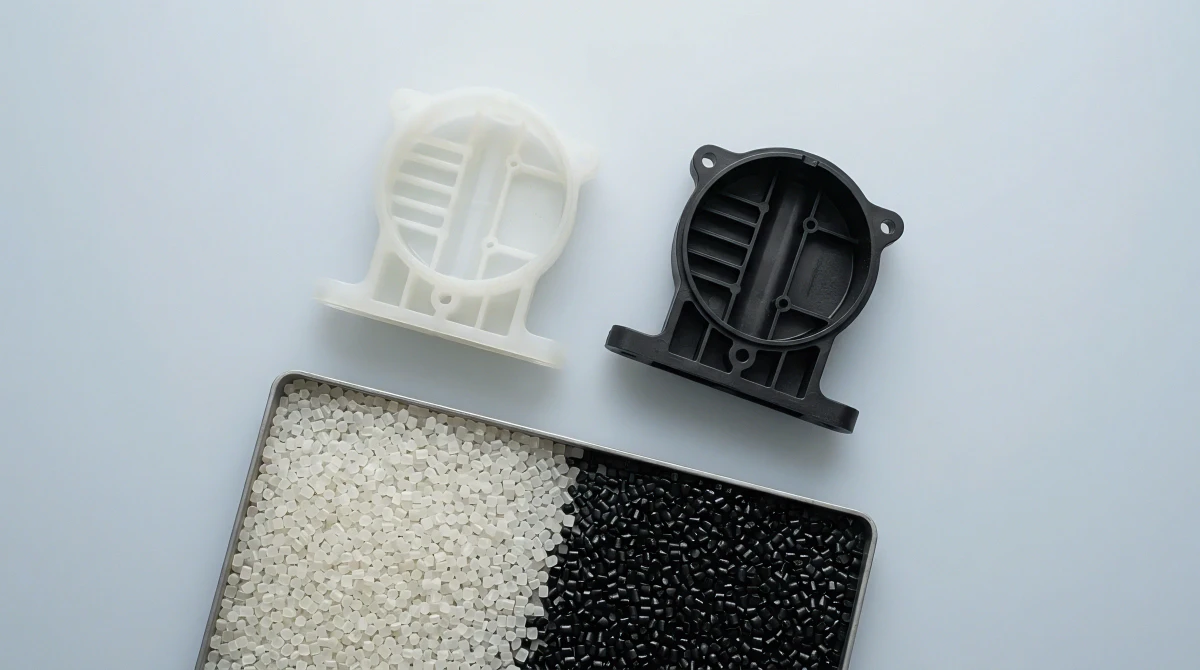
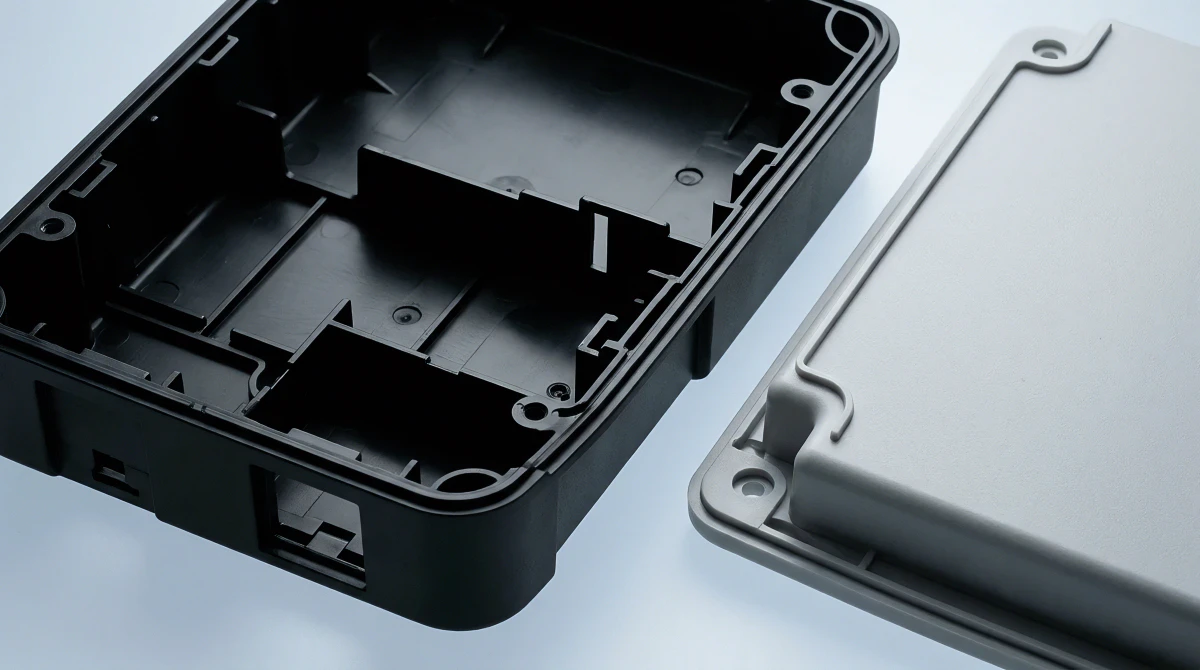
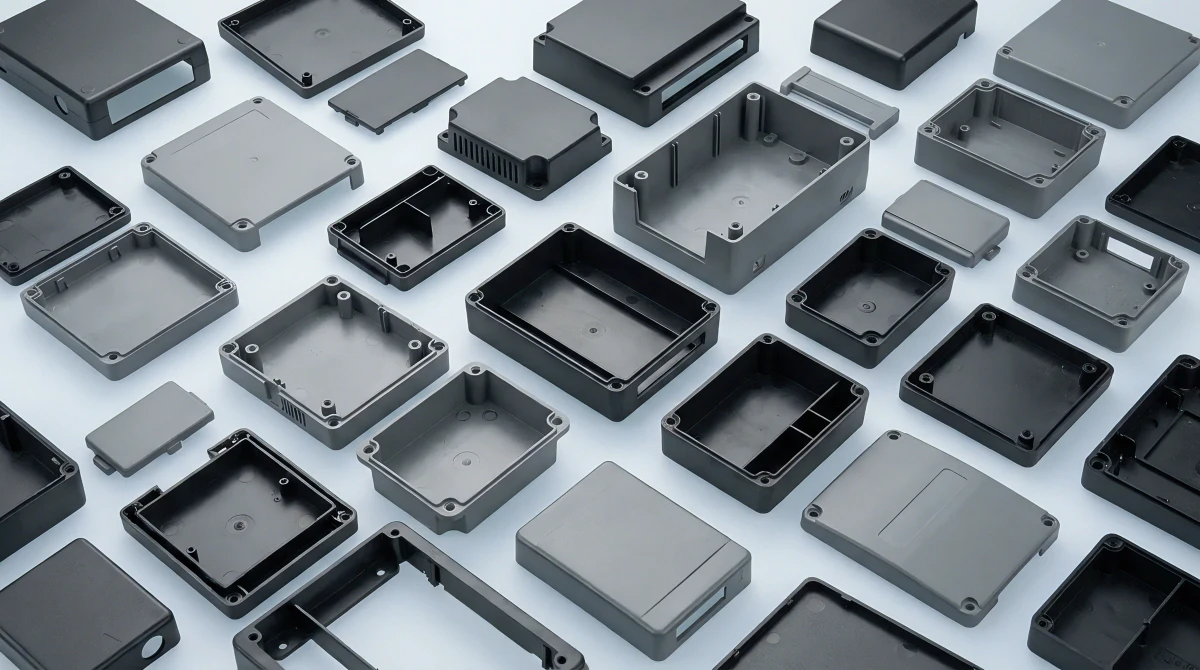
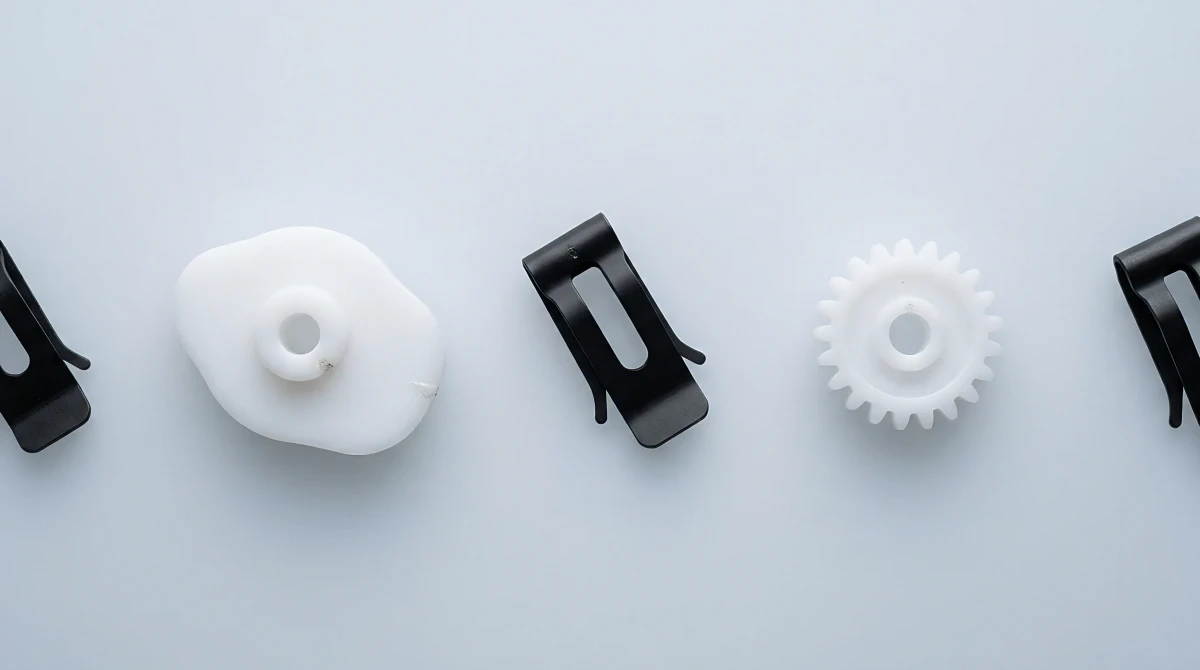
Acetal, written POM in the ISO system, is a stiff, low-friction semi-crystalline plastic molded for gears, clips, sliding guides and housings. DuPont describes its homopolymer as almost 60 percent crystalline, among the most crystalline of thermoplastics. That crystallinity explains its large shrinkage and its need for a well-packed gate. It takes up little water, so its parts hold dimension in damp air.Shrinkage Mechanism
The melt weighs 1.17 g/cm³ and the solid 1.42 g/cm³, a gap of 18 percent. DuPont’s pressure-volume diagram puts 11 percent of the volume loss in crystallization. A further 7 percent comes from cooling the solid, about 2 percent in linear dimensions. Packing can replace only the first loss, and only while the gate is open. Delrin 500P prints molding shrinkage of 2.0 percent along the flow and 1.9 percent across it under ISO 294-4. A 100 mm (3.94 in) dimension therefore needs a cavity of about 102.04 mm.Read More
Melt Window
DuPont recommends a melt of 215 °C (419 °F) with a tolerance of 5 °C for standard grades. At that temperature the resin stays stable for more than 30 minutes. The nozzle and hot runner run at 190 °C (374 °F), and higher settings degrade the melt after a few hours. A hotter melt shortens the time the resin may sit in the barrel. A molten purge dropped in water sinks when sound and floats when it carries degradation gas. Acetal never runs with PVC, other halogenated polymers or flame-retardant resins, whose acid gases attack it.Packing and Ejection
A semi-crystalline resin fails by under-packing. In a conical gate acetal crystallizes in the narrow tip before packing ends, which costs up to 30 percent in mechanical performance. DuPont asks for a tunnel gate in the thickest area, at least half the wall in diameter and under 0.8 mm (0.03 in) long. The mold runs at 80 to 100 °C (176 to 212 °F) and hold pressure at 80 to 100 MPa (11,600 to 14,500 psi). The datasheet gives 8 s of hold per millimeter of wall as an average. Once packing has finished, acetal is solid and needs no further cooling in the mold. DuPont ejects it hot onto a conveyor and lets it cool in air. On its test part, 15 s of packing and 2 s of cooling gave a 26 s cycle. That setting held the 49.6 mm (1.95 in) diameter to ±0.02 mm. Adding 15 s of mold cooling raised the cycle to 41 s and the spread to ±0.07 mm.Gauge Reading
Water absorption at equilibrium is 0.20 percent, a fraction of what nylon takes up. Thermal expansion is the larger effect at 1.0E-4 per °C. A 100 mm length grows 0.10 mm for every 10 °C, so a gauge room 10 °C warm reads 0.10 mm long. Annealing at 160 °C (320 °F) for 30 minutes per millimeter of wall is optional and changes the dimension.Datasheet Limits
Acetal numbers come with a time and a notch attached. The tensile creep modulus falls from 2,800 MPa at 1 hour to 1,600 MPa at 1,000 hours. Notched Charpy impact is 9.0 kJ/m² against 320 kJ/m² unnotched, a factor of 35. A clip is designed on the long-term modulus, and a gear tooth gets a root radius. Delrin 500P is UL 94 HB at 0.8 and 1.5 mm, with an oxygen index of 22 percent. Its burning rate under ISO 3795 is 20 mm/min (0.79 in/min) at 1 mm. A part that needs a class above HB needs another resin. The grade is named in full, because a homopolymer sheet does not cover copolymer grades. The color and its masterbatch are cleared with the resin maker before the order, since some pigments degrade the melt.Aluminum Tool
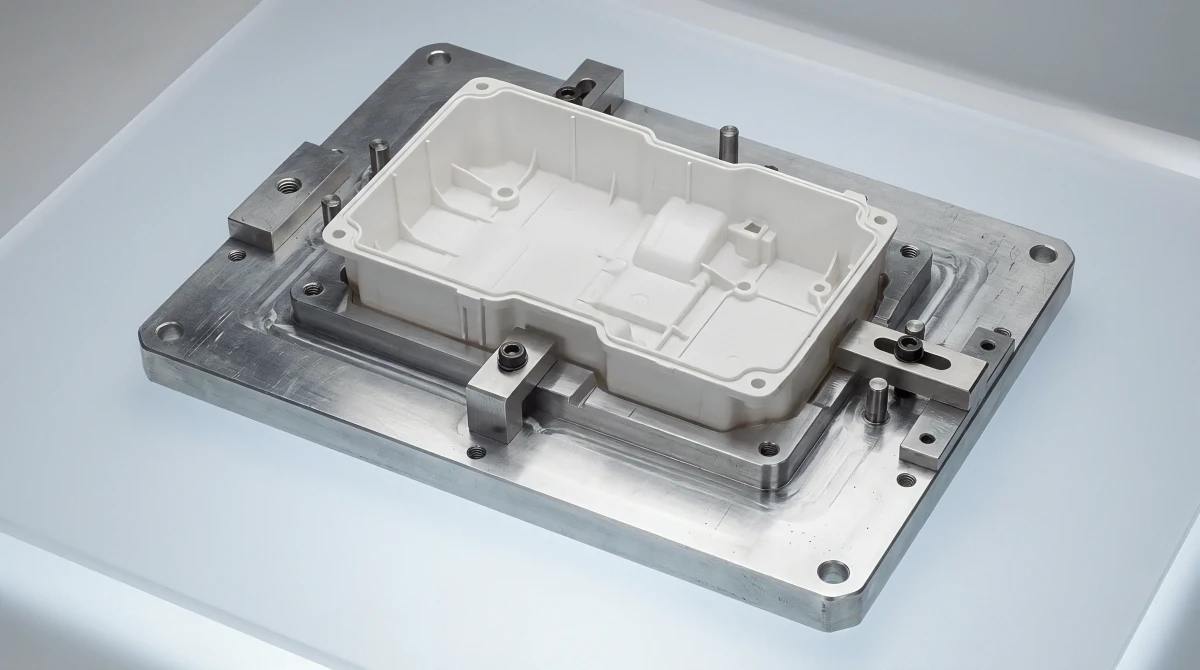
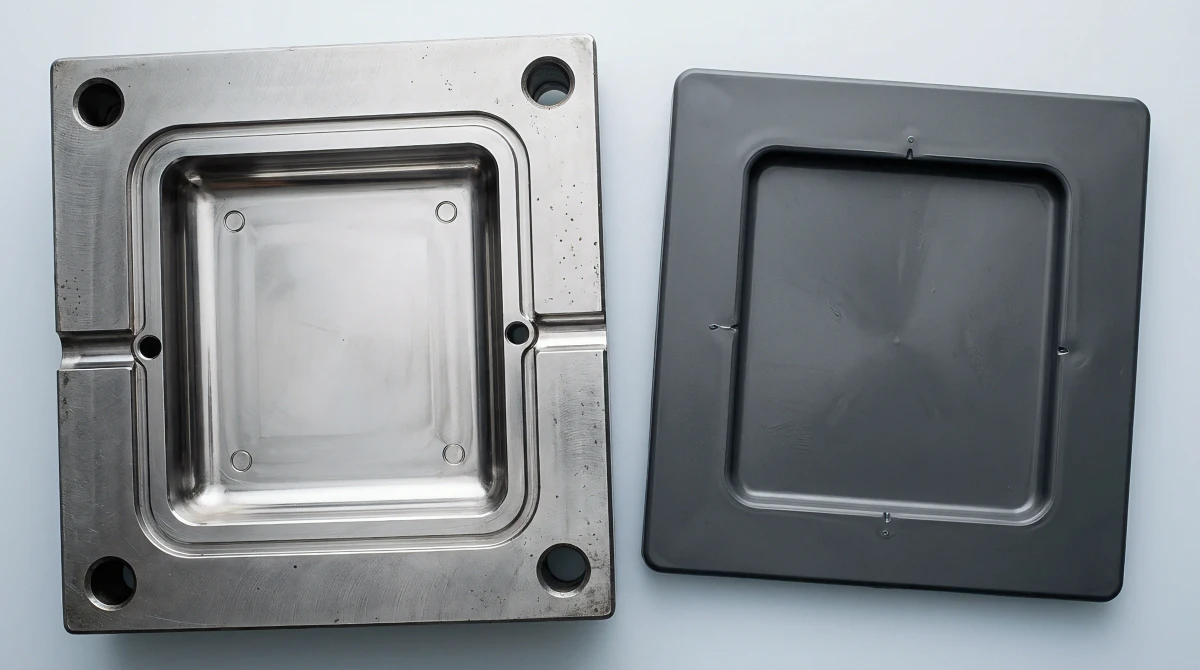
An aluminum tool suits acetal on two conditions. The resin carries no glass, so abrasive wear on gates and shutoffs is not the first concern. The gate land, 0.8 mm (0.03 in) long at most, is checked at each cleaning, because its wear changes the packing first. The tool runs at 80 to 100 °C and the part leaves hot. The ejection system and the receiving conveyor therefore belong to the dimensional plan.