Nylon

Nylon is the polyamide family, nylon 66 and nylon 6 among it, that absorbs water from the air and is molded only after drying.

Every Nylon article of the Injection Molding Resources, newest first, each written from published standards, research and makers’ data.

Meaning

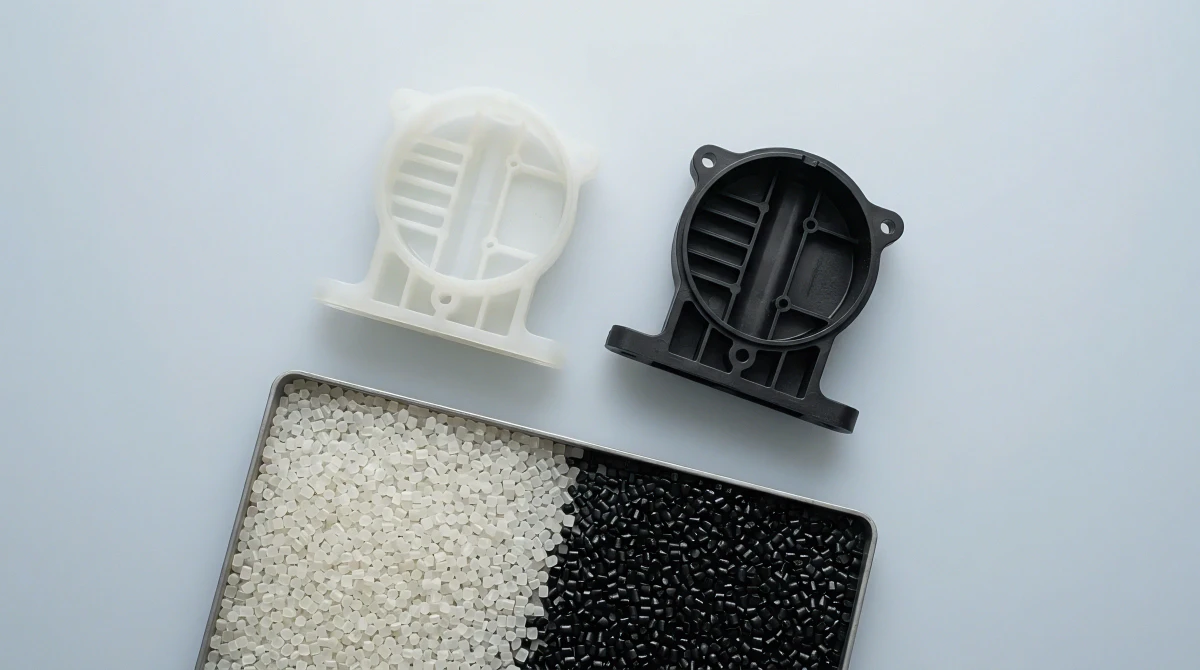
Nylon is the polyamide family, nylon 66 and nylon 6 among it, that absorbs water from the air and is molded only after drying. It is semi-crystalline, and DuPont’s Zytel and Minlon molding guide is the reference the articles here read it from. The same polymer serves unreinforced and with glass fiber, and the two behave differently in the tool. Water sets much of its story, both in the pellet before molding and in the part after it.

Moisture Limit

DuPont sets the ceiling at 0.2 percent water by weight before the pellets reach the screw. Water carried into the melt triggers hydrolysis, which breaks the polymer down and costs toughness and strength. The same water lowers melt viscosity, so a wet melt can over-pack the part and the runner. Later processing cannot repair resin degraded this way. Fresh bags are dried 2 to 4 hours at 80 °C (175 °F). The dryer air holds a dew point below -18 °C (about 0 °F). Air flow is set at 3.0 to 3.7 m³/h for each kg/h of resin. Hotter melts and longer cycles lower the moisture a nylon can carry, to 0.1 percent above 315 °C (600 °F).
Read More

Melt and Mold Window

Reinforced nylon 66 runs at a melt of 285 to 305 °C (545 to 580 °F). Reinforced nylon 6 runs at 260 to 280 °C (500 to 540 °F). Both take a mold of 70 to 120 °C (155 to 250 °F), with 100 °C (210 °F) preferred. Unreinforced grades take a mold about 30 °C (50 °F) cooler. Flame-retardant grades take a melt about 15 °C (25 °F) cooler. A cold machine starts 10 °C (20 °F) below the lowest melt temperature and soaks for at least 20 minutes. Back pressure stays low, near 0.3 MPa (50 psi), and thin sections fill in 1 to 3 seconds.

Shrinkage and Swell

DuPont applies the highest possible hold pressure to reduce mold shrinkage, usually around 90 MPa (13,050 psi). A change of 10 MPa (1,450 psi) moves shrinkage by about 0.1 percent. On a 100 mm (3.94 in) dimension that is 0.1 mm from one setting. The correct hold time is found by weighing parts, and shrinkage reaches its minimum where weight peaks. Once hold has finished the crystallization, the part needs no separate cooling to be stiff enough to eject. The guide measures shrinkage on a 60 by 60 by 2 mm plate at 23 °C, dry as molded. The plate first rests 24 to 48 hours at 23 °C and 50 percent relative humidity. A nylon part keeps moving after it leaves the press. Post-mold crystallization shrinks it while absorbed water swells it. In a well-molded part of moderate wall the swell wins. A part molded cold or thin shows the opposite, and the guide links a cold mold to high post-mold shrinkage and internal stress. Unreinforced nylon 66 reaches 2.5 percent water at equilibrium in air at 23 °C and 50 percent relative humidity. In water it reaches 7.5 percent. Notched impact strength climbs with humidity, so a test dry as molded and a test after conditioning describe different parts.

Glass Reinforcement

Glass fiber makes nylon directional. The 33 percent glass grade expands 1.8E-5 per °C along the flow and 8.3E-5 per °C across it. For 10 °C, a 100 mm length grows 0.018 mm along the flow and 0.083 mm across it. Glass-reinforced resins also wear the barrel, the screw and the mold. DuPont reports that treated bimetallic barrels, screws and check rings last 5 to 10 times as long as standard ones.

Press Capacity

A screw melts less nylon per hour than polystyrene. ARBURG lists 2.8 kg/h (6.2 lb/h) of PA 6.6 for the 20 mm screw of its ALLROUNDER 370 A. The 40 mm screw of the same press melts 12.5 kg/h (27.5 lb/h). A cycle that consumes more resin than the screw can melt cannot be held.

Flame Class

The heat-stabilized 33 percent glass grade is UL 94 HB at 0.75 and 1.5 mm. Glass and heat stabilization do nothing for burning behavior. A drawing that needs V-0 names a flame-retardant nylon, which is a different grade with its own sheet.
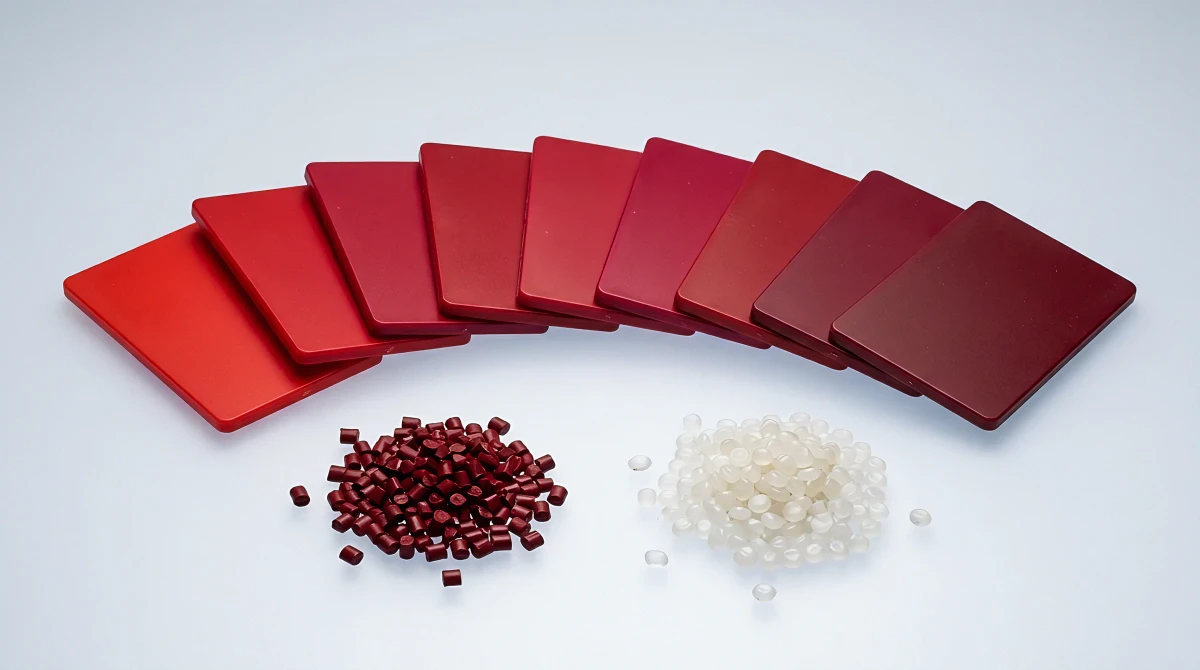
Color Matching Molded Parts With Masterbatch in a Production Run

How masterbatch color is matched, dosed, distributed and measured so that every lot of a molded part matches the standard agreed at the first article.

How Masterbatch Color Is Held Across a RunThree things have to stay constant for color to hold. The masterbatch has to be the same formulation at the same let-down ratio, the melt has to distribute it evenly, and the part has to be measured the same way each time.

Short Shot, Sink and Flash in Injection Molding Traced to Their Cause

Short shots, sinks and flash traced to the melt volume, pressure and steel behind them, with the checks that find the cause before a setting is moved.

What Short Shots, Sink and Flash Have in CommonA short shot is a part the cavity never finished. BASF's troubleshooting brochure for engineering thermoplastics describes it as a part not completely formed, mainly in the areas furthest from the gate or in thin walls.

Gate Location and Gate Freeze in Injection Molding

Where a gate goes, how big it is and how long it stays open, with the weight study that sets hold time from the gate itself.

How Gate Location and Gate Freeze Shape a Molded PartAutodesk's Moldflow design rules open with the claim that gate position strongly affects material orientation and warpage, and that changing the gate is sometimes the only way to control orientation. Every gate injects under the same pressure, and the aim of gating is to avoid overpacking some paths while others are still filling, because unequal packing gives unequal shrinkage.

Draft Angle by Texture Depth on Injection Molded Parts

How much draft a textured wall needs for its depth, under which conditions each published figure holds, and how the mold and the part are checked.

How Much Draft a Texture Depth NeedsStandex Engraving Mold-Tech's technical data sheet gives the current recommendation from the texture maker: 1° of draft for every 0.013 to 0.015 mm (0.0005 to 0.0006 in) of texture depth. Per 0.025 mm (0.001 in) that works out to between 1.7° and 2°.

IEC 60695-2-12 Glow Wire Flammability Index for Molded Parts

The glow wire flammability index read for a buyer: what IEC 60695-2-12 measures, how makers print it by thickness, and what a molded part's file can carry from it.

What IEC 60695-2-12 MeasuresThe scope, printed on the IEC webstore and in the 2021 preview, is short. The standard specifies the details of the glow wire test applied to specimens of solid electrical insulating materials, or other solid materials, to determine the glow wire flammability index, GWFI.

How Many Parts One Aluminum Injection Mold Gives

A mold's life is a toolmaker's rating for a stated resin and cavity count, converted into parts per tool and then into tools per quantity.

What Sets the Number of Parts One Aluminum Mold GivesThree things set it, and they act together. One is the alloy and where in the plate the cavity sits.

Cycle Time and Parts per Hour in a Bridge Injection Molding Run

A cycle is the sum of fill, hold, cooling and press motions, and a supplier's number is only as good as the pack and cooling times behind it.

What Sets Cycle Time and Parts per HourA molding cycle is a loop of seven moves: the mold closes, the cavity fills, the pack and hold phase runs, the part cools, the mold opens, the part is ejected, and the screw recovers for the next shot. Recovery runs while the part cools, which is why DuPont's nylon guide asks for screw speeds adjusted so that screw retraction time is shorter than the cooling phase.

How to Start Up an Injection Mold and Take the First Shots

A new mold is started cold on purpose, filled in stages with short shots, and read for vents, gates and heat before any process is fixed.

The Start-Up Sequence from a Cold Barrel to the First ShotEight moves take a machine from cold to its first complete part. The first four prepare the melt, the next three shape the shot, and the last one is a decision: whether the part describes the tool or only the settings.

Drying Resin and Setting Melt Temperature Before the First Injection Molded Part

Pellets are dried to a measured moisture limit, held there to the hopper, and melted inside a window that the resin maker prints.

What Dry Resin and a Correct Melt Temperature ProtectWater in a nylon melt is not a surface problem. DuPont explains that water carried into the melt triggers hydrolysis, which breaks the polymer down, costs toughness and strength, and makes the melt flow more easily.

How Temperature Changes the Size of a Molded Plastic Part at the Gauge

How coefficients of expansion turn a few degrees of gauge temperature into hundredths of a millimeter, by resin and direction, and what a drawing should state.

Linear Thermal Expansion of Polycarbonate, Glass-Filled Nylon and AcetalLinear thermal expansion is reported on datasheets as a coefficient, the length change per unit length per degree. The three makers print it by the ISO or TMA method, and they differ in how finely they split it.

Injection Molding Shrinkage Along and Across the Flow by Material

Molding shrinkage read by direction and condition for three resins, with the process settings that move it and the way a first sample turns it into a cavity allowance.

Shrinkage of Polycarbonate, Glass-Filled Nylon 66 and Acetal Along and Across the FlowISO 294-4:2018 sets out the method for measuring mold shrinkage and post-mold shrinkage of injection molded thermoplastic test specimens, parallel and normal to the direction of melt flow. Resin makers print the result in two lines, one per direction.

ISO 20457 Tolerances for Plastic Molded Parts Read for the Buyer

How ISO 20457 is worded for plastic molded parts, what a supplier signs when a drawing cites it, and which items stay outside it for the order to settle.

What ISO 20457 Covers for Injection Molded PartsAccording to the abstract published by the Swedish Institute for Standards (SIS), ISO 20457 specifies possible manufacturing tolerances for plastic moulded parts, and it covers all integral features with general tolerances, using a surface profile tolerance within a specified datum system. It applies to injection moulding, injection compression moulding, transfer moulding, compression moulding and rotational moulding of non-porous parts in thermoplastics, thermoplastic elastomers and thermosets.

Glass-Filled Nylon 66 in Injection Molding and What It Does to an Aluminum Tool

How a glass-reinforced nylon behaves dry and conditioned, in the press and on an aluminum tool, and what its datasheet leaves for the buyer to settle.

Properties of 30 Percent Glass-Filled Nylon 66 Dry and ConditionedPA66 with 30 percent glass is one of the most common reinforced engineering grades, and BASF's Ultramid A3WG6 LT BK, a laser-transparent black grade whose sheet is dated 09/2026, is a clear example of how the family reads. The sheet names the polymer PA66-GF30 and gives its typical values for uncolored product at 23 °C.

Request an Injection Molding Quote

Send the 2D drawing and the 3D file, with the quantity and the stage of the project. An engineer replies within 1 working day.

The quote form, the mutual NDA and the private folder for your files are on Protolis Atelier, with Injection Molding chosen.

Request a Quote