Meaning
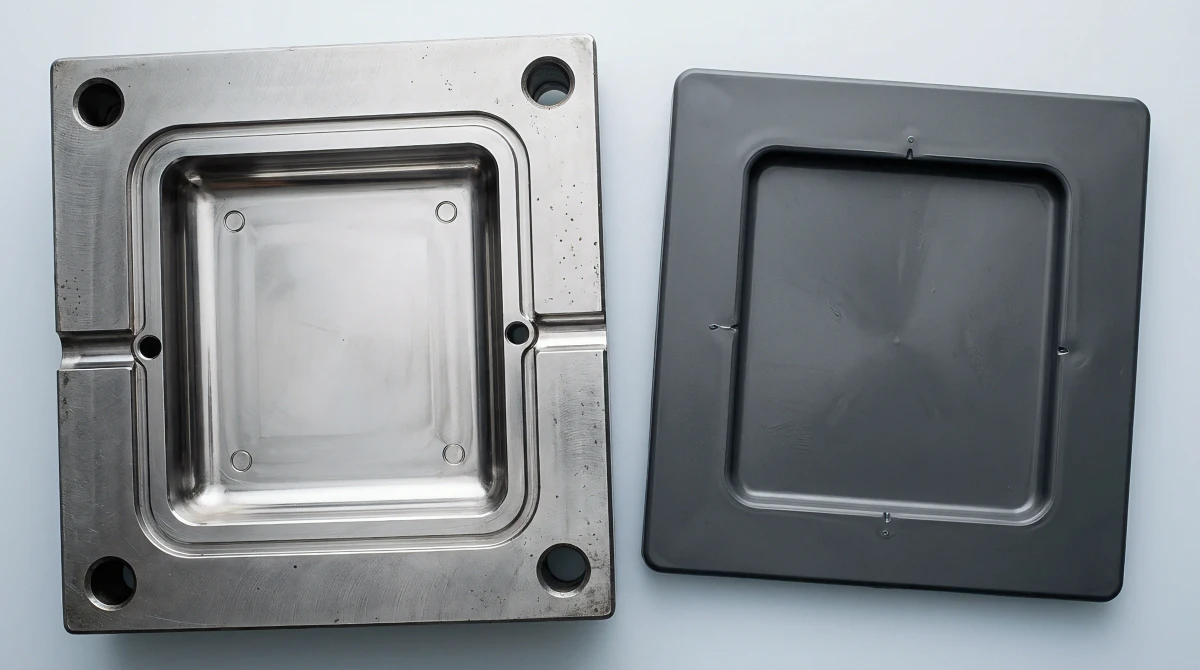
Shrinkage is the amount a molded part contracts from its cavity as it cools, given as a percent along and across the melt flow. Every cavity is cut larger by this amount. The printed figure belongs to a test plaque, not to a real part. A part’s own value is found on its first samples.Test Method
ISO 294-4 measures mold shrinkage on injection-molded thermoplastic specimens, parallel and normal to the flow. The common specimen is a 60 by 60 by 2 mm plate gated along one edge. The standard defines the value as free shrinkage, the maximum of any restricted shrinkage. It excludes humidity, which belongs to post-mold and total shrinkage. The current text is edition 3 of December 2018, confirmed in 2024. A printed value belongs to the conditions that produced it. Makrolon 2407 specimens are molded at a 280 °C melt, an 80 °C mold and 200 mm/s injection velocity. The same sheet recommends a 300 °C melt and a 70 to 110 °C mold for production. The Zytel sheet lists 295 °C melt, a 100 °C mold and hold pressures of 50 to 100 MPa. A production part molded at its own best conditions is not the plaque behind the number.Read More
Typical Range
Makrolon 2407 polycarbonate prints 0.65 percent along the flow and 0.70 percent across it. For real parts Covestro gives 0.5 to 0.7 percent under ISO 2577. Zytel 70G33HS1L, a 33 percent glass nylon 66, prints 0.30 percent along and 1.1 percent across. Delrin 500P acetal prints 2.0 percent along and 1.9 percent across. On a 100 mm (3.94 in) length those figures run from 0.30 mm to 2.0 mm. Acetal shrinks most because it crystallizes, losing 11 percent of its volume to crystallization and 7 percent to cooling. Glass fibers lie along the flow and hold the polymer there, so glass nylon shrinks least along the flow. Amorphous polycarbonate shrinks little and almost equally in both directions. A small gap between the two directions keeps the part’s shape, and a large gap changes it.Process Effect
DuPont’s nylon guide gives the process effects. Shrinkage rises with mold temperature, because a hot mold lets the polymer crystallize more fully. It rises with wall thickness, because a thick section cools slowly. Hold pressure lowers it, and a 10 MPa (1,450 psi) change moves it by about 0.1 percent. Shrinkage reaches its minimum at the hold time where part weight peaks. A part from a short hold shrinks more than the later production parts. A real part has ribs, bosses and walls that hold it. A feature held between walls shrinks less than the free value, and a long clear span shrinks close to it. The printed pair is therefore a better estimate for a flat, evenly walled part gated at one edge. It is a weaker estimate for deep ribs, thick bosses or several gates.Moisture
Humidity sits outside the ISO 294-4 value, so for nylon the figure describes the dry state only. The glass nylon grade takes up 1.8 percent water at equilibrium in a 2 mm wall. That swell comes after the shrinkage was measured, and the sheet gives no dimensional change for it. Acetal at 0.20 percent and polycarbonate at 0.12 percent carry far less of this effect.Error Types
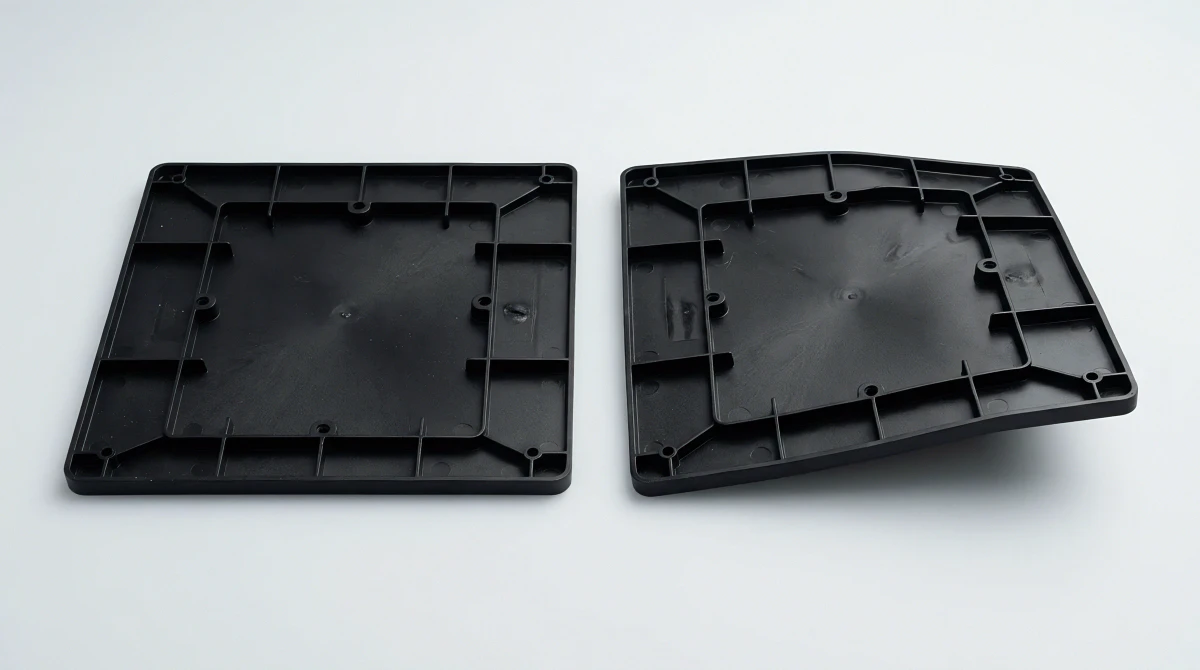
A wrong allowance is a systematic error, found on the first sample and corrected in the cavity. A process drift is a random error, controlled by fixed hold pressure, hold time and mold temperature. An orientation effect is a shape error, controlled by gate position and a lower glass content where the use allows. On a 120 by 80 mm glass nylon cover, one 0.7 percent allowance leaves the part 0.48 mm long and 0.32 mm short.Measurement
A part measured warm looks as if it shrank less. A gauge room 10 °C above 23 °C hides 0.065 points on polycarbonate and 0.100 points on acetal. That error is the same order as a 10 MPa hold pressure change. A first sample is therefore measured at a stated temperature, after a stated time, in a stated moisture state. The toolmaker states the allowance in each direction and the datasheet figure behind it. The cavity is corrected where the allowance missed, and the corrected conditions go on the setup sheet.