Meaning
Tensile creep modulus is a plastic’s stiffness under a constant load held over time, printed at 1 hour and at 1,000 hours under ISO 899-1. It falls as the load stays on. A part that carries a steady load, a clip, a boss or a gear, is designed on the long-term figure. The short-term tensile modulus overstates what such a part keeps.Values
Delrin 500P acetal reads 2,800 MPa (406,000 psi) at 1 hour and 1,600 MPa (232,000 psi) at 1,000 hours, a fall of 43 percent. Makrolon 2407 polycarbonate reads 2,200 MPa (319,000 psi) at 1 hour and 1,900 MPa (276,000 psi) at 1,000 hours, a fall of 14 percent. Their short-term tensile moduli are 3,100 MPa and 2,400 MPa.Read More
Design Effect
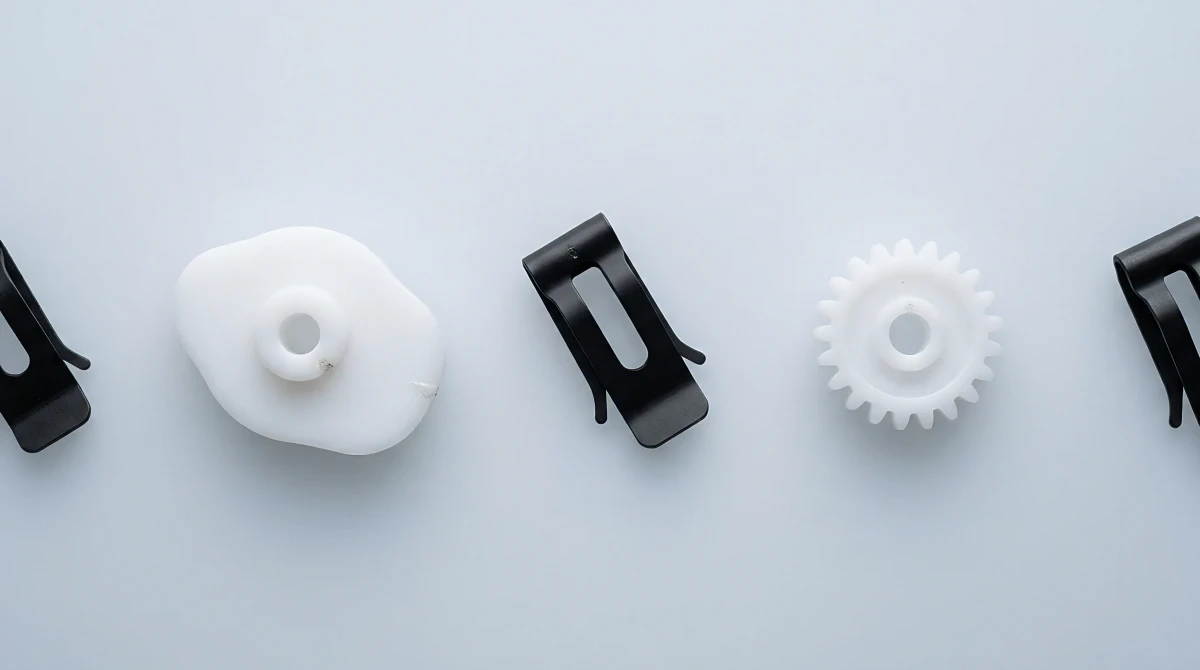
A clip held deflected for months loads the material in creep. Taking the deflection at acetal’s 1,000-hour modulus gives a stress about 48 percent lower than the short-term figure suggests for the same strain. A clip designed on the short-term number relaxes in service. A polycarbonate snap hook or screw boss under steady load is designed on its lower figure too.Conditions
Each value is for a bar at 23 °C. A part warmer than that, or carrying stress from molding, keeps less. The sheet’s multi-point data give creep curves a designer can ask for by name.Acetal Uses
For a gear or guide, the 1,000-hour modulus sits beside the 0.20 percent water absorption and the tooth root radius. For a housing with a screw boss, it sits beside the expansion of 1.0E-4 per °C against the screw’s own.