Residence Time

Residence time is how long resin sits melted in the barrel before it is injected, also called hold-up time.

Every Residence Time article of the Injection Molding Resources, newest first, each written from published standards, research and makers’ data.

Meaning

Residence time is how long resin sits melted in the barrel before it is injected, also called hold-up time. Every melt temperature window comes with a residence limit. Hotter melt allows less time. A shot too small for the barrel stretches the time over many cycles.

Acetal Limit

DuPont’s Delrin tips plot melt temperature against maximum residence time. At the recommended 215 °C (419 °F), standard grades stay stable for more than 30 minutes. As the melt gets hotter, the allowed time shrinks. The melt temperature and the time in the barrel are therefore read together against that plot.
Read More

Nylon Profiles

DuPont’s nylon guide matches processing temperatures to hold-up times. Its cylinder profiles are drawn for hold-up times of 3, 7 and 11 minutes. Cylinder temperatures fall as residence time grows.

Shot Size

A shot that fills a small part of the barrel leaves melt there for several cycles. DuPont’s guide asks that the press or screw be sized so the shot weight is not too low. Long cycles from insert placing make it worse. Covestro sets a shot stroke of 2 to 3 screw diameters to protect its polycarbonate.

Long Residence

Covestro pictures a screw, nozzle and check ring after about an hour at molding temperature. Residue builds on the flights and check ring, the screw can seize and the nozzle can clog. The screw then has to be pulled and cleaned.

Press Choice

A press far too large for the part keeps resin in the barrel for many cycles. A press too small cannot melt enough to keep the cycle. Both limits are read from the maker’s data sheet before the cycle is quoted.

Short Shot, Sink and Flash in Injection Molding Traced to Their Cause

Short shots, sinks and flash traced to the melt volume, pressure and steel behind them, with the checks that find the cause before a setting is moved.

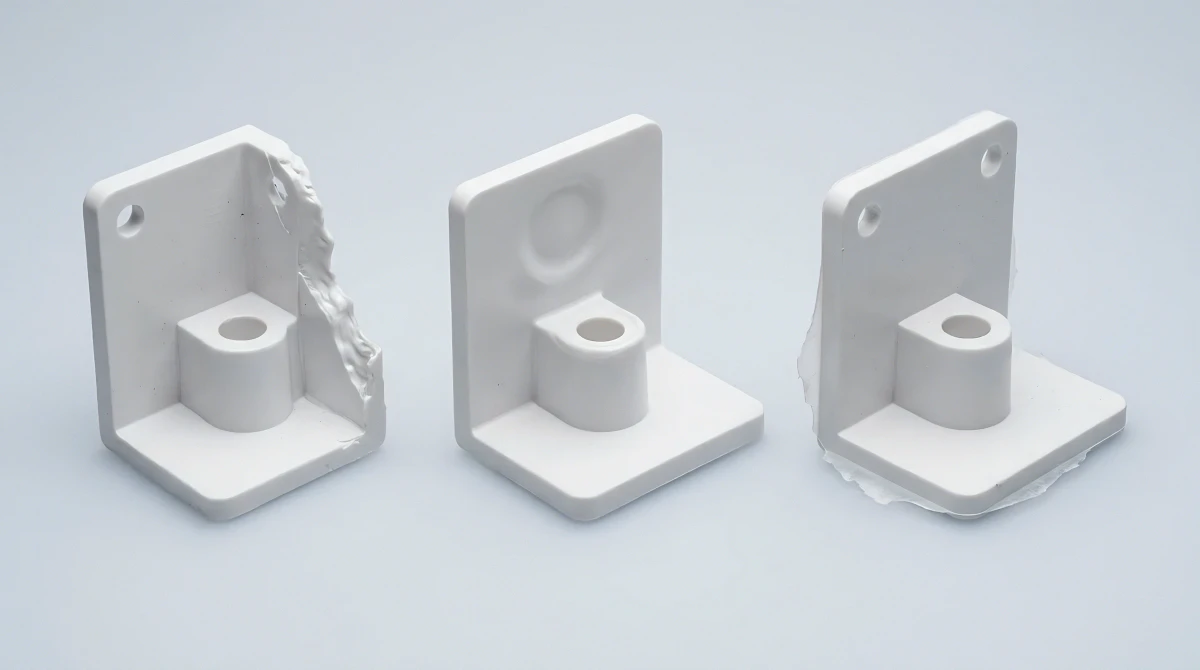
What Short Shots, Sink and Flash Have in CommonA short shot is a part the cavity never finished. BASF's troubleshooting brochure for engineering thermoplastics describes it as a part not completely formed, mainly in the areas furthest from the gate or in thin walls.
ABS and PC/ABS Blends in Injection Molding

ABS and PC/ABS read from the makers' datasheets: drying, processing windows, shrinkage, snap-fit strain, impact and when the blend earns its stricter dryer.

How ABS and PC/ABS Differ in Injection MoldingABS is a terpolymer, and Moldflow's material page describes its structure: a continuous phase of styrene-acrylonitrile with a dispersed phase of polybutadiene rubber. Acrylonitrile brings hardness and chemical and heat resistance, styrene brings processability, gloss and strength, and butadiene brings toughness and impact strength.

Cycle Time and Parts per Hour in a Bridge Injection Molding Run

A cycle is the sum of fill, hold, cooling and press motions, and a supplier's number is only as good as the pack and cooling times behind it.

What Sets Cycle Time and Parts per HourA molding cycle is a loop of seven moves: the mold closes, the cavity fills, the pack and hold phase runs, the part cools, the mold opens, the part is ejected, and the screw recovers for the next shot. Recovery runs while the part cools, which is why DuPont's nylon guide asks for screw speeds adjusted so that screw retraction time is shorter than the cooling phase.

Drying Resin and Setting Melt Temperature Before the First Injection Molded Part

Pellets are dried to a measured moisture limit, held there to the hopper, and melted inside a window that the resin maker prints.

What Dry Resin and a Correct Melt Temperature ProtectWater in a nylon melt is not a surface problem. DuPont explains that water carried into the melt triggers hydrolysis, which breaks the polymer down, costs toughness and strength, and makes the melt flow more easily.

Acetal Homopolymer Injection Molding Properties and Gate Rules

Delrin 500P read from the maker's sheet and molding tips: why acetal shrinks and needs a packed gate, how hot the melt may run, and what to check on an aluminum tool.

Delrin 500P Properties in Metric and Inch UnitsDelrin 500P NC010 is a medium-viscosity acetal homopolymer, and Delrin prints its ISO values as the reference beside 500CPE on its own product data sheet. The grade has a melt mass-flow rate of 15 g/10 min at 190 °C and 2.16 kg under ISO 1133.

Request an Injection Molding Quote

Send the 2D drawing and the 3D file, with the quantity and the stage of the project. An engineer replies within 1 working day.

The quote form, the mutual NDA and the private folder for your files are on Protolis Atelier, with Injection Molding chosen.

Request a Quote