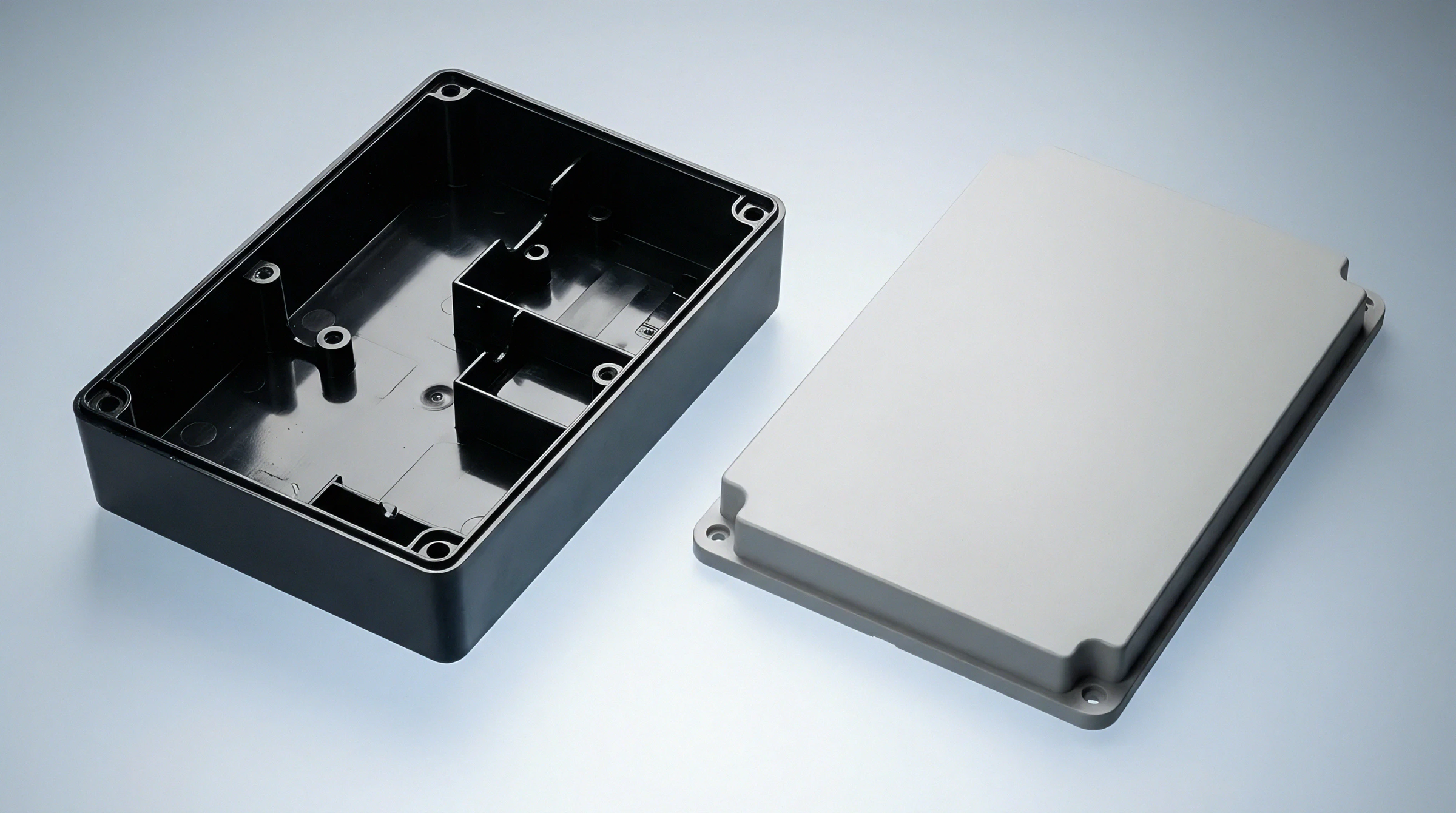
Autodesk’s Moldflow material notes let ABS go into the barrel with up to 0.1 % moisture. Covestro’s datasheet for Bayblend T85 X, a PC/ABS blend, sets the ceiling at 0.01 %, ten times drier. The two resins look alike in a molded housing, share a styrene backbone and often come out of the same tools, yet the polycarbonate in the blend changes what the dryer, the barrel and the part’s service temperature have to deliver.
ABS and PC/ABS are the two workhorse amorphous resins for housings, covers and enclosures. This piece reads them as they behave in an injection mold: what the makers’ datasheets print, how each is dried and processed, how they shrink and warp, how their snap fits and impact strength compare, and where the blend replaces ABS on flame-retardant parts. It is a material selection guide built from the makers’ own sheets.
How ABS and PC/ABS Differ in Injection Molding
ABS is a terpolymer, and Moldflow’s material page describes its structure: a continuous phase of styrene-acrylonitrile with a dispersed phase of polybutadiene rubber. Acrylonitrile brings hardness and chemical and heat resistance, styrene brings processability, gloss and strength, and butadiene brings toughness and impact strength. The ratios can be varied widely, which is why the same page notes there are hundreds of ABS grades on the market.
PC/ABS blends polycarbonate into that structure. Plastics Technology’s comparison of PC/ABS and PC/PBT, written by engineers at The Madison Group, describes the result: polycarbonate’s impact strength, stiffness and heat resistance, combined with the processability and low-temperature performance of ABS. Polycarbonate’s glass transition is around 150 °C (302 °F), and adding ABS lowers the blend’s slightly, which still leaves PC/ABS holding stiffness to higher temperatures than many alternatives.
The practical difference for a molder is the polycarbonate. It is a condensation polymer, and the same article notes that hydrolysis of the PC phase is not offset by the ABS. That is the reason for the tighter drying limit, and the reason neither PC/ABS nor PC/PBT is recommended for hot water service.
ABS is the easier resin to mold. PC/ABS trades a stricter dryer for more heat, more impact strength and a better match to polycarbonate parts.
Typical Properties From the Makers’ Datasheets
Trinseo publishes MAGNUM ABS grades with three properties, and Covestro publishes full ISO datasheets for two Bayblend PC/ABS grades. The values below are typical values from those sheets; Covestro notes that they are not a binding specification and can shift with mold design, processing and pigment.
| Property (test) | MAGNUM 3453 ABS | MAGNUM 8391 ABS | MAGNUM 8434 ABS | Bayblend T85 X PC/ABS | Bayblend RW85 XF PC/ABS |
|---|---|---|---|---|---|
| Melt flow, ABS at 220 °C/10 kg (ISO 1133), PC/ABS as MVR at 260 °C/5 kg | 15 g/10 min | 28 g/10 min | 13 g/10 min | 18 cm³/10 min | 15 cm³/10 min |
| Vicat softening temperature | 97 °C (207 °F), B50 | 95 °C (203 °F), B50 | 100 °C (212 °F), B50 | 131 °C (268 °F), B120 | 128 °C (262 °F), B120 |
| Notched Charpy, 23 °C (ISO 179/1eA) | 18 kJ/m² | 16 kJ/m² | 18 kJ/m² | 60 kJ/m² | Not printed |
| Notched Izod, 23 °C (ISO 180/A) | Not printed | Not printed | Not printed | 57 kJ/m² | 42 kJ/m² |
| Tensile modulus (ISO 527) | Not printed | Not printed | Not printed | 2,300 MPa (334,000 psi) | 2,400 MPa (348,000 psi) |
| Yield stress (ISO 527) | Not printed | Not printed | Not printed | 56 MPa (8,100 psi) | 49 MPa (7,100 psi) |
| HDT at 1.80 MPa (ISO 75) | Not printed | Not printed | Not printed | 106 °C (223 °F) | 101 °C (214 °F) |
| Molding shrinkage, parallel and normal (ISO 294-4) | Not printed | Not printed | Not printed | 0.55 to 0.75 % | 0.6 to 0.8 % |
| Density (ISO 1183) | Not printed | Not printed | Not printed | 1,140 kg/m³ (71.2 lb/ft³) | 1,180 kg/m³ (73.7 lb/ft³) |
Three readings stand out. The Vicat temperatures of the PC/ABS grades are about 30 to 35 °C (54 to 63 °F) higher, though they are measured at a higher load and heating rate, so the gap is indicative rather than exact. Notched Charpy is three to four times higher for T85 X than for the ABS grades. And the ABS flow figures span a factor of about two between MAGNUM 8434 and 8391, which is the difference between a grade chosen for heat and gloss and one chosen for very high flow.
Covestro’s T85 X sheet adds the low-temperature numbers that make PC/ABS a housing material: a notched Charpy of 47 kJ/m² at −30 °C (−22 °F), and a puncture force of 4,500 N (1,010 lbf) at 23 °C rising to 5,400 N (1,210 lbf) at −30 °C. The Madison Group article explains the source. The butadiene in ABS carries low-temperature impact resistance, and the PC/ABS blend keeps it.
Drying ABS and PC/ABS Before Molding
Moisture limits are the clearest difference between the two families, and the makers set them precisely.
| Material | Drying | Moisture maximum | Melt temperature | Mold temperature |
|---|---|---|---|---|
| ABS, generic (Moldflow) | 80 to 90 °C (176 to 195 °F), at least 2 h | 0.1 % | 200 to 280 °C (392 to 536 °F), aim 230 °C (446 °F) | 25 to 80 °C (77 to 176 °F) |
| PC+ABS, generic (Moldflow) | 90 to 110 °C (194 to 230 °F), 2 to 4 h | 0.04 % | 230 to 300 °C (446 to 572 °F) | 50 to 100 °C (122 to 212 °F) |
| Bayblend T85 X (Covestro) | 95 to 110 °C (203 to 230 °F), 4 h, dry air | 0.01 % | 270 to 290 °C (518 to 554 °F), standard 280 °C (536 °F) | 70 to 90 °C (158 to 194 °F) |
| Bayblend RW85 XF (Covestro) | 95 to 110 °C (203 to 230 °F), 4 h, dry air | 0.02 % | 240 to 280 °C (464 to 536 °F), standard 270 °C (518 °F) | 60 to 100 °C (140 to 212 °F) |
Covestro notes that its drying conditions are for dry-air dryers and that other dryer types may need different times and temperatures. The generic Moldflow values are wider than either grade’s sheet, which is the usual relation between a family page and a grade datasheet: the grade sheet is the one to set the dryer by.
ABS is not free of moisture either. Moldflow describes ABS grades as hygroscopic and requires drying before processing. Trinseo states that its mass-polymerized MAGNUM grades take up less moisture than regular ABS, which shortens pre-drying, a claim made against emulsion ABS rather than a figure.
For PC/ABS the drying step is part of the material, not a precaution. The Plastics Technology interview on flame-retardant PC/ABS puts it plainly: drying is mandatory and should be completed to specification.
Melt Temperature, Mold Temperature and Gloss
Covestro’s RW85 XF sheet gives the fullest processing window of the five grades, written for a standard three-zone barrel: rear 230 to 240 °C (446 to 464 °F), middle 235 to 245 °C (455 to 473 °F), front 240 to 270 °C (464 to 518 °F) and nozzle 265 to 275 °C (509 to 527 °F). It adds a hold pressure of 50 to 75 % of injection pressure, a specific back pressure of 50 to 150 bar (725 to 2,180 psi), a peripheral screw speed of 0.05 to 0.2 m/s (10 to 39 ft/min), a shot size of 30 to 70 % of barrel capacity and a vent depth of 0.025 to 0.075 mm (0.001 to 0.003 in).
Two of those numbers carry over to tool and press choice. The shot-to-barrel ratio of 30 to 70 % limits how small a part can run on a large barrel before residence time becomes a problem. The vent depth range is the one cut into the parting line for this grade.
For ABS, Moldflow adds an injection pressure range of 50 to 100 MPa (7,250 to 14,500 psi) and a moderate to high injection speed, and notes that mold temperature controls gloss, with lower mold temperatures giving lower gloss. Trinseo makes the same point for its grades, which reach their gloss targets through mold temperature, melt temperature and injection speed, and adds that its MAGNUM resins have been processed above 250 °C (482 °F) without the thermal instability it attributes to typical ABS. For PC+ABS, Moldflow asks for an injection speed as high as possible.
Surface quality also depends on gel content. Trinseo offers low-gel and ultra-low-gel versions of some grades for furniture and automotive interior parts where the surface is the product.
ABS gloss is set at the mold temperature controller. PC/ABS asks for a hotter barrel, a drier pellet and a mold at 60 °C (140 °F) or more.
Shrinkage, Warpage and Sink in PC/ABS
PC/ABS shrinks little and evenly. Both Covestro grades print the same range parallel and normal to flow under ISO 294-4, 0.55 to 0.75 % for T85 X and 0.6 to 0.8 % for RW85 XF, so a flat part has no directional shrinkage difference built in by the resin. The Madison Group article describes PC/ABS as offering good flow and low shrinkage, with the ABS component contributing low warpage and the blend able to hold tight tolerances on complex shapes.
BASF’s troubleshooting brochure gives the reason from the other side. One of its remedies for warpage is a low-warpage material such as a blend with an amorphous phase, because the gap between lengthwise and crosswise shrinkage that drives warpage is smaller.
Sink marks behave differently. In a study reported by Plastics Technology, run at GE’s Polymer Process Development Center on a PC/ABS and a PPE/PS resin, the protruding boss pin, a method recommended for about two decades, did poorly in PC/ABS. Heat-removal methods, a beryllium copper boss pin, a beryllium copper insert and an actively cooled pin, all reduced sink in PC/ABS, and a spring-loaded pin cut sink by up to 50 % when its preload was tuned. The result is a reminder that a sink fix proven in one resin is not automatically right for the blend.
Snap Fits, Impact and Service Temperature
Bayer’s snap-fit design guide, written for its own engineering plastics, gives a permissible short-term strain for Bayblend PC/ABS of 2.5 % at 23 °C (73 °F), against 4 % for unreinforced Makrolon polycarbonate and 3.5 % for Makroblend polycarbonate blends. For joints that are separated and rejoined often, the guide uses about 60 % of those values, which brings PC/ABS to about 1.5 %.
The same guide lists friction coefficients against steel, which set the assembly force of a snap fit. ABS reads 0.50 to 0.65, with a factor of 1.2 for ABS against ABS, while PC reads 0.45 to 0.55. A PC/ABS hook pressed into an ABS housing slides with friction near the top of that range, and the mating force is designed on it.
| Material | Permissible short-term strain, single assembly, 23 °C (73 °F) | Frequent separation, about 60 % | Friction against steel |
|---|---|---|---|
| Bayblend PC/ABS | 2.5 % | About 1.5 % | Not listed as a blend |
| Makroblend PC blends | 3.5 % | About 2.1 % | Not listed as a blend |
| Makrolon PC, unreinforced | 4 % | About 2.4 % | 0.45 to 0.55, factor 1.2 PC on PC |
| ABS | Not listed | Not listed | 0.50 to 0.65, factor 1.2 ABS on ABS |
Service temperature is set by heat deflection more than by Vicat. Covestro prints HDT at 1.80 MPa (261 psi) of 106 °C (223 °F) for T85 X and 101 °C (214 °F) for RW85 XF, with linear expansion of 0.7 × 10⁻⁴ per K (3.9 × 10⁻⁵ per °F) parallel and normal for T85 X. The Madison Group article adds the environmental limits: PC and ABS resist thermal oxidation only below their glass transitions, the butadiene in ABS is the component most sensitive to UV, and PC/ABS formulations for strong UV exposure normally include stabilizers. Trinseo reports up to 50 % less yellowing for its MAGNUM grades than for typical ABS in accelerated weathering. Before the tool exists, a team often handles vacuum cast parts in an ABS-like resin to judge the housing, and the figures above are what those copies are standing in for.
Flame-Retardant ABS Moving to PC/ABS
Flame-retardant ABS has long relied on antimony trioxide as a synergist, and Plastics Technology’s interview with two engineers at a materials distributor describes a shift. With antimony supply uncertain, many programs are moving from FR ABS to FR PC/ABS, which keeps most of the moldability, surface finish and paintability while adding heat and impact performance.
The interview is specific about the limits:
- FR PC/ABS can replace most FR ABS in injection molded parts with limited tool adjustments, but knit lines, venting and wall thickness targets deserve review.
- Some antimony-based FR ABS grades still reach higher flame ratings at thin walls, for example UL 94 5VA at a given thickness, than the PC/ABS alternatives.
- If the wall thickness is fixed, the choices are to change the geometry, accept a different rating where allowed, or move to a higher-performance material family.
- Gloss and color depth are good in FR PC/ABS, though very light colors need tighter compounding and color control.
Covestro’s RW85 XF datasheet describes the grade as suitable for use in electrical and electronic devices, and the T85 X sheet prints a comparative tracking index of 225 V under IEC 60112 and an electric strength of 40 kV/mm (1,016 V/mil) at 1 mm. The flame ratings themselves belong to the grade’s maker and its UL file, and each is read at the thickness printed there.
Choosing Between ABS and PC/ABS for a Molded Part
The datasheets reduce the choice to a short set of questions:
- Does the part see temperatures near 90 to 100 °C (194 to 212 °F) in service? If so, the PC/ABS heat deflection values are the ones that leave margin.
- Does it have to survive impact at low temperature? The −30 °C (−22 °F) impact rows of PC/ABS answer for that.
- Is it colored in the molding cell with masterbatch? Trinseo’s natural ABS grades are offered for exactly that, with a white base that needs less pigment for light colors.
- Does it carry snap fits that are assembled often? The 2.5 % strain of PC/ABS, cut to about 60 % for repeated use, sets the hook geometry.
- Is a flame rating required at a thin wall? The rating at that thickness, from the grade’s own file, decides between FR ABS, FR PC/ABS and another family.
Either resin runs in an aluminum or a steel tool, and either can be sampled in several grades from one cavity, since their shrinkage figures sit close together. For low-volume injection molding in bridge production, the grade’s own datasheet sets the dryer, the barrel and the vent depth, and the part’s service temperature and impact case decide whether the polycarbonate is worth the stricter drying.
Sources and Further Reading
- Bayblend T85 X Technical Datasheet, version 2026-07-02, Covestro
- Bayblend RW85 XF ISO Datasheet, edition 19 September 2023, Covestro
- MAGNUM ABS Resins Brochure, EMEA, Trinseo
- MAGNUM ABS Resins Fast Fact Sheet, North America, 2024, Trinseo
- ABS materials, Moldflow 2014 help, Autodesk
- PC+ABS materials, Moldflow 2015 help, Autodesk
- Snap-Fit Joints for Plastics, A Design Guide (copy hosted by MIT Fab Academy), Bayer MaterialScience
- Polymer Showdown, PC/ABS and PC/PBT, Plastics Technology
- Q&A, Antimony-Free Alternatives for Flame-Retardant ABS, Plastics Technology
- How to Reduce Sinks in Injection Molding, Plastics Technology
- Injection-Molding Problems in Engineering Thermoplastics, Causes and Solutions, BASF