Meaning
Moisture is the water carried by resin pellets before molding and by a molded part after it, given as a percent of weight. In the pellet it decides whether the melt is sound. In the part it decides the size and the stiffness read at the gauge. Nylon is the resin most affected, acetal and polycarbonate much less.Limit Before Molding
DuPont sets the ceiling for Zytel and Minlon nylon at 0.2 percent by weight. Covestro sets its thermally conductive polycarbonate a decade lower, below 0.02 percent. Delrin 500P is dried 2 to 4 hours at 80 °C (176 °F) to a maximum of 0.20 percent. Hotter melts and longer cycles lower the limit, and DuPont asks for 0.1 percent above 315 °C (600 °F). None of these numbers can be read from the pellets by eye.Read More
Effect in the Melt
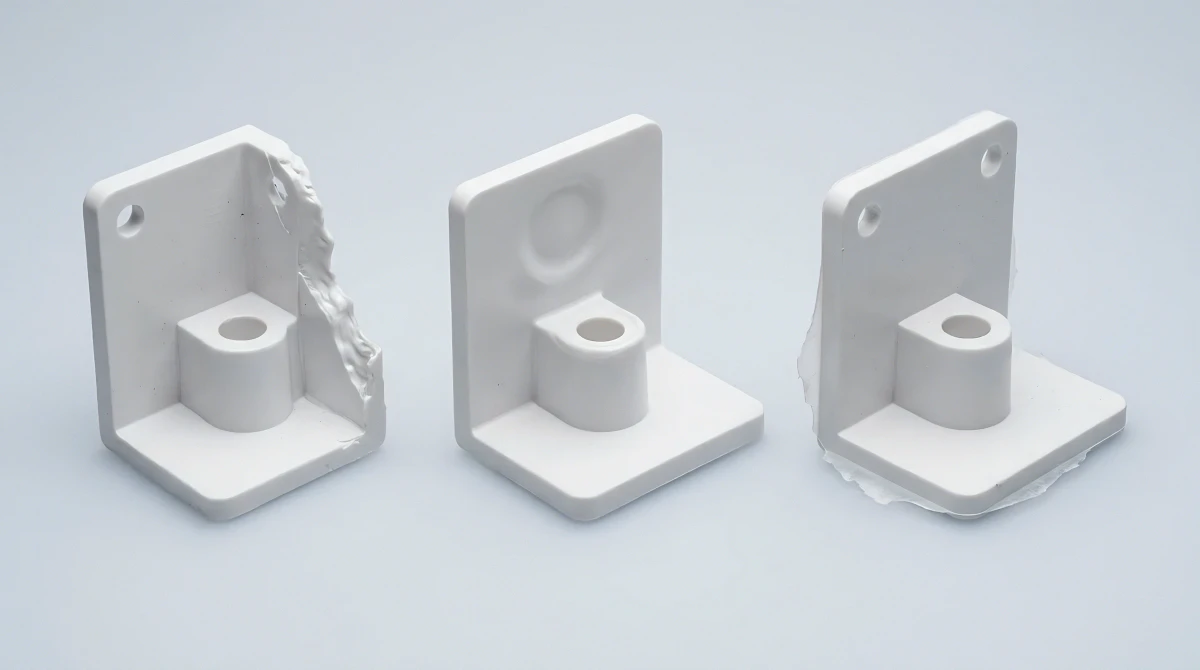
Water in a nylon melt triggers hydrolysis, which breaks the polymer and costs toughness and strength. Later processing cannot repair it. High moisture also lowers melt viscosity, so the resin can over-pack the part and the runner. Steam from excess water shows as splay marks and internal bubbles. Sticking and flash may appear even while mechanical properties still pass. DuPont notes that hydrolysis and polycondensation both run during processing, shifting molecular weight and melt viscosity. Water, melt heat and hold-up time act together and are hard to separate. A drifting pressure signal sends the setter back to all three.Press Signals
A moisture meter is the direct check, but the process reports moisture three ways. Wet resin splutters and bubbles in an air shot, and it leaves splay on the part. The third signal is pressure. DuPont’s dynamic pressure drop uses two transducers in the cavity. Its chart for a 2.0 mm wall separates resin at 0.08, 0.15 and 0.22 percent moisture. A change in moisture can then be read without stopping the press.Handling
Virgin DuPont nylon is supplied dry and may be used from sealed containers below 0.2 percent. Hopper drying still follows, so pellets in the hopper do not take water from the room. DuPont advises against tray ovens that feed the hopper by hand, because pellets regain water fast enough to make molding drift. Dry resin can be wetted again between the dryer and the screw. DuPont asks for containers stored cold to reach the molding-area temperature before they are opened. The hopper holds no more than an hour of resin, with the lid tight. Opened bags are resealed, and stock rotates first in, first out. Regrind takes up moisture from humid air faster than virgin pellets, so it goes through the same dryer.Uptake After Molding
A part leaves the tool nearly dry and starts absorbing water at once. Glass-filled nylon 66 reaches 1.8 percent at equilibrium at 23 °C and 50 percent relative humidity in a 2 mm wall. It reaches 5.7 percent at saturation. Unreinforced nylon 66 reaches 2.5 percent in air and 7.5 percent in water. DuPont conditions such parts to about 3 percent and lets the surface water evaporate, which leaves about 2.5 percent. Acetal stops at 0.20 percent and polycarbonate at 0.12 percent, both under ISO 62. Water swells a nylon part while post-mold crystallization shrinks it. Where the wall is moderate and the molding sound, swell outweighs shrinkage. DuPont’s plot of moisture against time runs to 300 days for walls of 1.5, 3.2 and 6.4 mm. A gauge check on a fresh sample and one on a conditioned sample are two different measurements. The sheets give no figure for the swell of the glass grade, and an acetal tolerance budget leaves moisture swell unquantified too.Drawing and Record
A nylon dimension names its moisture state, dry as molded or conditioned at 23 °C and 50 percent relative humidity. The first-sample report carries the same state beside each value. Production parts are then compared with the sample in the state it was measured in. A moisture reading before molding belongs in the lot record with the dryer log. Hours at temperature, dew point and the date of the filter change make a record a buyer can compare with the maker’s limits.