V-0

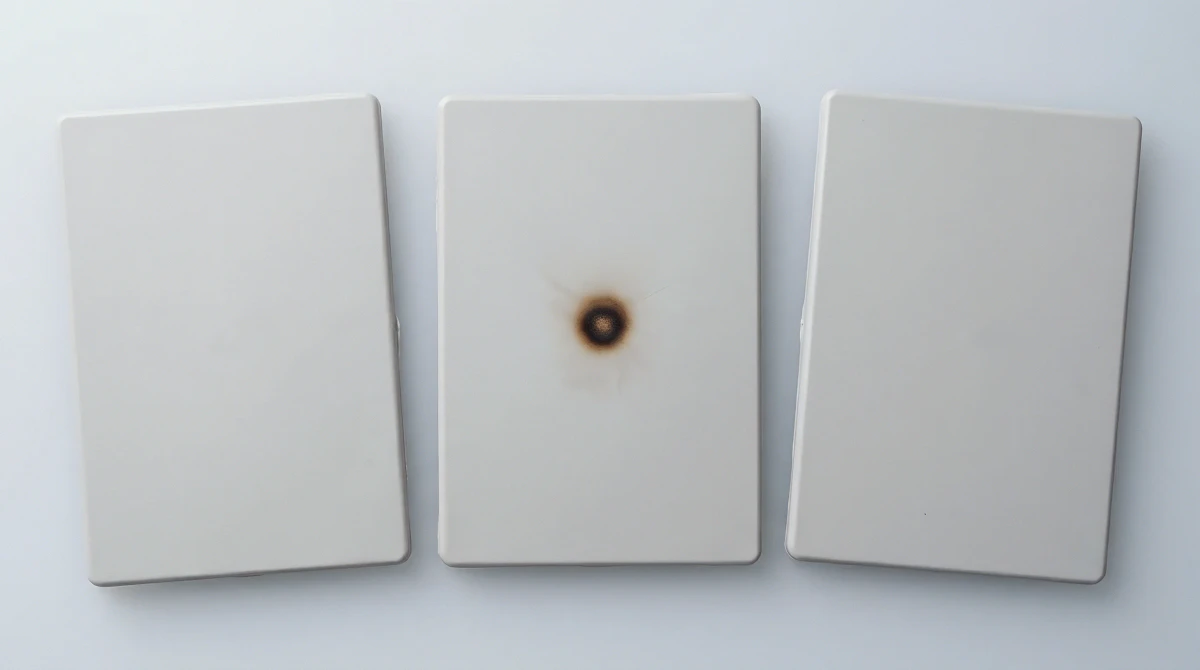
V-0 is the strictest vertical-burn class of UL 94: each strip stops burning within 10 seconds, and no drip ignites cotton.

Every V-0 article of the Injection Molding Resources, newest first, each written from published standards, research and makers’ data.

Meaning

V-0 is the strictest vertical-burn class of UL 94: each strip stops burning within 10 seconds, and no drip ignites cotton. It is earned at a stated thickness. None of the three base grades read in these resources reaches it at any wall printed. A part that needs it names a flame-retardant grade.

Test

A strip 12.7 by 127 mm (0.5 by 5 in) is held vertically. A 20 mm flame from a 50 W burner touches it twice for 10 seconds. Five specimens make a set. Each afterflame stays at 10 seconds or less. The set of five stays at 50 seconds or less in total. Flame plus glow after the second application stays at 30 seconds or less, and no drip may ignite the cotton below.
Read More

Worked Reading

A set of five gives ten afterflame readings sharing 50 seconds, an average of 5 seconds each. A resin that burns 9 seconds after every application fails V-0 on the set total. Each single reading would still be inside the 10 second limit. V-1 and V-2 allow 250 seconds in total and 30 seconds per reading.

Class Difference

V-0, V-1 and V-2 use the same flame and procedure. V-2 allows flaming drips that ignite the cotton, and V-0 forbids them. A V-2 resin is therefore not half a V-0 resin.

Grades

Makrolon 2407 is V-2 at 0.75 mm and HB at 2.7 mm. The Zytel glass nylon and Delrin acetal grades are HB at the walls listed. Glass and heat stabilization do nothing for burning behavior, so a nylon that needs V-0 is a flame-retardant grade.

IEC 60695-2-12 Glow Wire Flammability Index for Molded Parts

The glow wire flammability index read for a buyer: what IEC 60695-2-12 measures, how makers print it by thickness, and what a molded part's file can carry from it.

What IEC 60695-2-12 MeasuresThe scope, printed on the IEC webstore and in the 2021 preview, is short. The standard specifies the details of the glow wire test applied to specimens of solid electrical insulating materials, or other solid materials, to determine the glow wire flammability index, GWFI.
UL 94 Flammability Ratings Explained for Molded Plastic Parts

The UL 94 classes read as a buyer needs them: what each test does, how three common resin sheets print a rating, and what a supplier should show.

What UL 94 Measures and What It Is NotUL 94 is a family of small-scale flame tests on strips and plaques of plastic, run under laboratory conditions. UL's own page on combustion tests for plastics groups the classifications into twelve: HB, V-0, V-1 and V-2, 5VA and 5VB, VTM-0, VTM-1 and VTM-2, and HF-1, HF-2 and HBF for foams.

Polycarbonate Injection Molding Properties for Clear and Tough Parts

Polycarbonate read from the maker's sheets for a buyer: what it molds like when dry and hot, how thin walls fill, and what to ask of an aluminum tool.

Makrolon 2407 Properties in Metric and Inch UnitsMakrolon 2407 is a low-viscosity, general-purpose, UV-stabilized, easy-release polycarbonate with a melt volume-flow rate of 19 cm³/10 min at 300 °C and 1.2 kg under ISO 1133. Its ISO short name is ISO 7391-PC,MLR,(,,)-18-9.

Glass-Filled Nylon 66 in Injection Molding and What It Does to an Aluminum Tool

How a glass-reinforced nylon behaves dry and conditioned, in the press and on an aluminum tool, and what its datasheet leaves for the buyer to settle.

Properties of 30 Percent Glass-Filled Nylon 66 Dry and ConditionedPA66 with 30 percent glass is one of the most common reinforced engineering grades, and BASF's Ultramid A3WG6 LT BK, a laser-transparent black grade whose sheet is dated 09/2026, is a clear example of how the family reads. The sheet names the polymer PA66-GF30 and gives its typical values for uncolored product at 23 °C.

Request an Injection Molding Quote

Send the 2D drawing and the 3D file, with the quantity and the stage of the project. An engineer replies within 1 working day.

The quote form, the mutual NDA and the private folder for your files are on Protolis Atelier, with Injection Molding chosen.

Request a Quote