Warpage

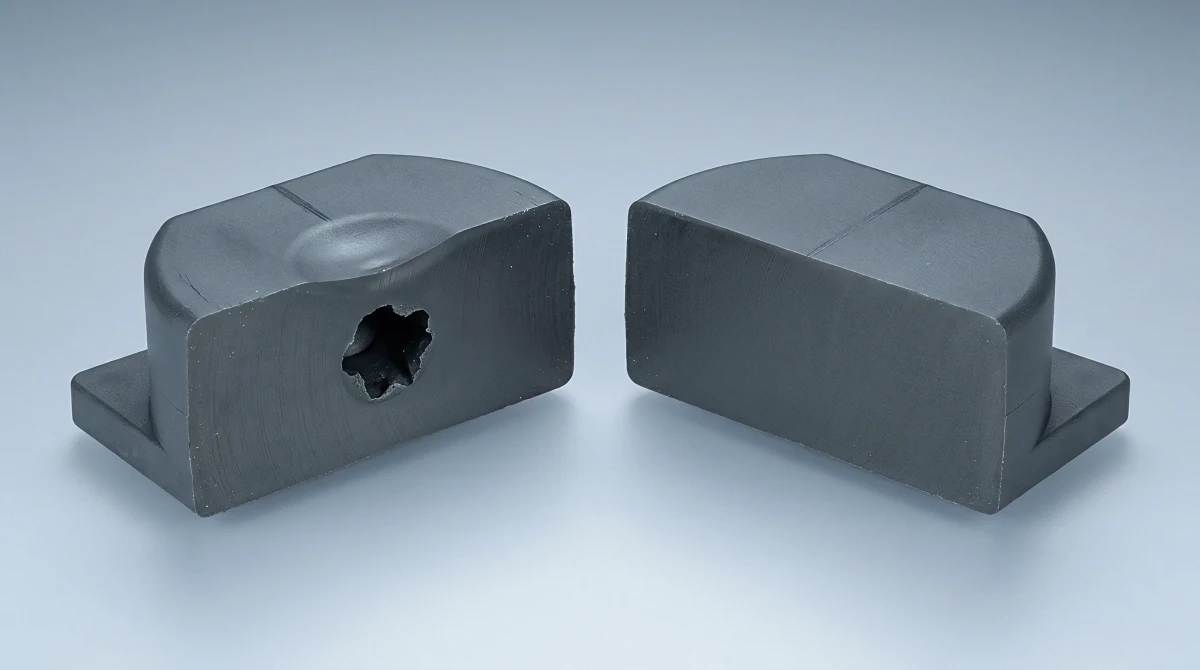
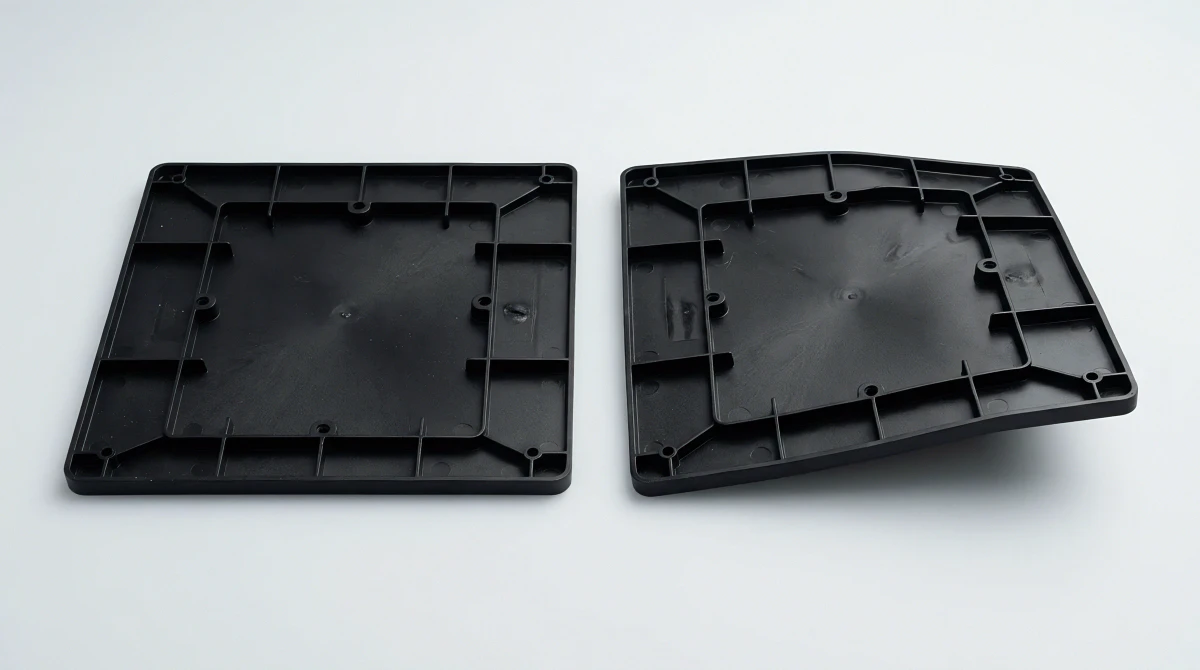
Warpage is the distortion of a molded part out of its intended shape, caused by uneven shrinkage across the part.

Every Warpage article of the Injection Molding Resources, newest first, each written from published standards, research and makers’ data.

Meaning

Warpage is the distortion of a molded part out of its intended shape, caused by uneven shrinkage across the part. It appears when one direction, one region or one face shrinks more than another. In glass-filled nylon the fibers cause it. In acetal, poor packing and restraint in the mold cause it.

Glass Fiber Cause

DuPont’s nylon guide names fiber orientation, non-uniform wall thickness and non-uniform mold temperature as the causes. Local overheating of cores and a missing water channel count under the last. The Zytel 70G33HS1L grade shrinks 0.30 percent along the flow and 1.1 percent across it. That ratio of nearly four to one is why glass nylon warps.
Read More

Glass Fiber Remedy

The guide’s remedies randomize the fibers. Abrupt flow changes, cores that split the melt and several gates all help. Blending to a lower glass content helps where the end use allows. A gate that makes the melt strike a core or wall also randomizes orientation.

Acetal Cause

DuPont’s Delrin tips link poor packing in a narrow gate to warpage, uncontrolled shrinkage and up to 30 percent loss of mechanical performance. Constraint adds to it. A part kept in the mold while it cools shrinks unevenly, with visible and measurable warpage and deformation.

Acetal Remedy

DuPont’s test part showed the least warpage at the packing time that gave the highest part weight, with the shortest cooling time. The part is ejected hot and cools in air without constraint. Ejecting into a box or bag creates a temperature gradient that may cause size differences between parts.

Annealing Risk

An annealing step can warp a complex part that hangs unsupported at 160 °C (320 °F). DuPont’s nylon guide advises trials to find milder conditions for such parts.

Gate Location and Gate Freeze in Injection Molding

Where a gate goes, how big it is and how long it stays open, with the weight study that sets hold time from the gate itself.

How Gate Location and Gate Freeze Shape a Molded PartAutodesk's Moldflow design rules open with the claim that gate position strongly affects material orientation and warpage, and that changing the gate is sometimes the only way to control orientation. Every gate injects under the same pressure, and the aim of gating is to avoid overpacking some paths while others are still filling, because unequal packing gives unequal shrinkage.
ABS and PC/ABS Blends in Injection Molding

ABS and PC/ABS read from the makers' datasheets: drying, processing windows, shrinkage, snap-fit strain, impact and when the blend earns its stricter dryer.

How ABS and PC/ABS Differ in Injection MoldingABS is a terpolymer, and Moldflow's material page describes its structure: a continuous phase of styrene-acrylonitrile with a dispersed phase of polybutadiene rubber. Acrylonitrile brings hardness and chemical and heat resistance, styrene brings processability, gloss and strength, and butadiene brings toughness and impact strength.

How Tightly Acetal Parts Hold Dimension in Injection Molding

Acetal dimension spread measured on one part under four press settings, with the gate and cooling rules behind it and a tolerance budget for a 50 mm feature.

Outer Diameter Spread Under Four Packing and Cooling SettingsThe test part in DuPont's tips is a tribological sample used for wear and friction testing, a part whose outer diameter has to be as dimensionally precise as possible. DuPont molded it under four settings, measured the outer diameter and reported the mean with its variation.

Glass-Filled Nylon 66 in Injection Molding and What It Does to an Aluminum Tool

How a glass-reinforced nylon behaves dry and conditioned, in the press and on an aluminum tool, and what its datasheet leaves for the buyer to settle.

Properties of 30 Percent Glass-Filled Nylon 66 Dry and ConditionedPA66 with 30 percent glass is one of the most common reinforced engineering grades, and BASF's Ultramid A3WG6 LT BK, a laser-transparent black grade whose sheet is dated 09/2026, is a clear example of how the family reads. The sheet names the polymer PA66-GF30 and gives its typical values for uncolored product at 23 °C.

Request an Injection Molding Quote

Send the 2D drawing and the 3D file, with the quantity and the stage of the project. An engineer replies within 1 working day.

The quote form, the mutual NDA and the private folder for your files are on Protolis Atelier, with Injection Molding chosen.

Request a Quote