V-2

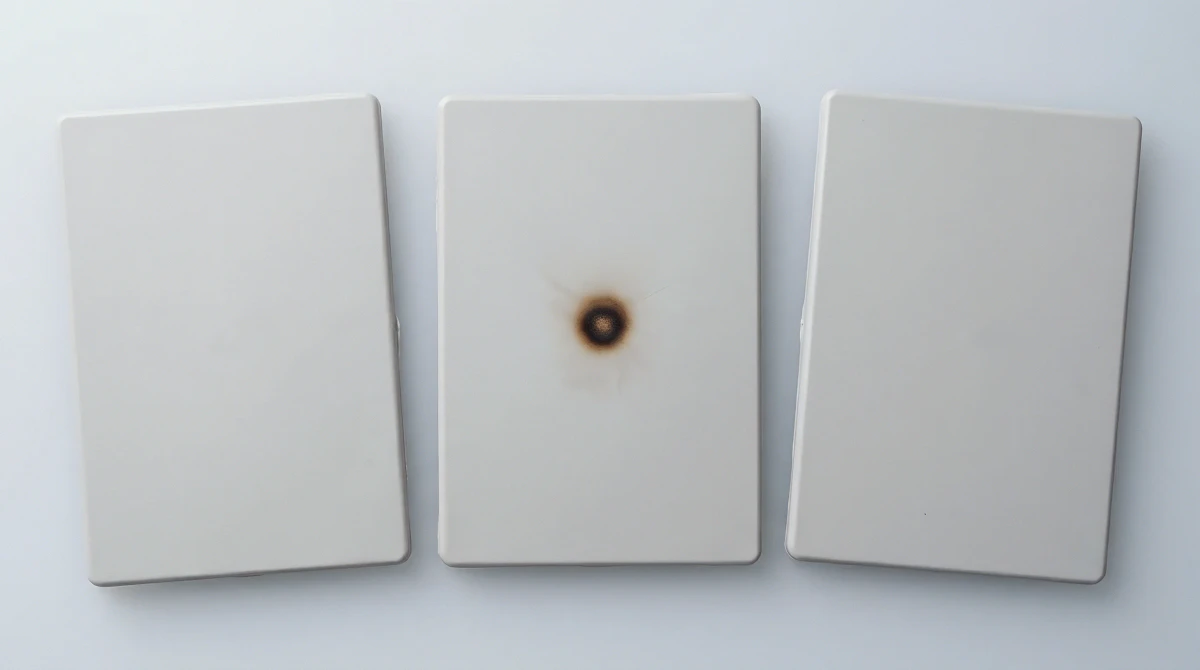
V-2 is a UL 94 vertical burn classification in which each specimen stops burning within 30 s after either of two 10 s flame applications, a set of five totals 250 s or less, and flaming drips that ignite the cotton below are allowed.

Every V-2 article of the Injection Molding Resources, newest first, each written from published standards, research and makers’ data.

Meaning

V-2 is a UL 94 vertical burn classification in which each specimen stops burning within 30 s after either of two 10 s flame applications, a set of five totals 250 s or less, and flaming drips that ignite the cotton below are allowed. It is the lowest of the three V classes.

Relation to V-0 and V-1

V-0, V-1 and V-2 use the same 50 W, 20 mm flame and the same procedure. V-1 has the same burn times as V-2 but forbids burning drips that ignite cotton; V-0 is stricter on time, with each specimen out in 10 s or less and a set of five in 50 s or less. A V-2 resin is therefore not half of a V-0 resin: a part that drips burning plastic onto something below is exactly the case V-2 admits and V-0 forbids.
Read More

Thickness

A V-2 rating belongs to a wall. Makrolon 2407 polycarbonate rates V-2 at 0.75 mm (0.030 in) and HB at 2.7 mm (0.106 in), so on that resin the thick region of a part is the weaker one under UL 94. The same sheet prints a glow wire flammability index of 850 °C at 0.75 mm under IEC 60695-2-12, which shows that a material can hold a high glow wire index at a wall where its UL 94 class is low.

On a Drawing

A buyer who needs V-0 in a thin wall names a flame-retardant grade rather than a general-purpose one, and the rating belongs to the grade, thickness and color recorded for it. Where a requirement is written as V-2, the drawing says at which wall it applies and whether burning drips are acceptable for the product’s position above other parts.

Other Fire Rows

V-2 is read beside the other fire tests on the same sheet, the glow wire index and ignition temperature, the needle flame test and the oxygen index, which an end product standard may ask for separately.
IEC 60695-2-12 Glow Wire Flammability Index for Molded Parts

The glow wire flammability index read for a buyer: what IEC 60695-2-12 measures, how makers print it by thickness, and what a molded part's file can carry from it.

What IEC 60695-2-12 MeasuresThe scope, printed on the IEC webstore and in the 2021 preview, is short. The standard specifies the details of the glow wire test applied to specimens of solid electrical insulating materials, or other solid materials, to determine the glow wire flammability index, GWFI.

UL 94 Flammability Ratings Explained for Molded Plastic Parts

The UL 94 classes read as a buyer needs them: what each test does, how three common resin sheets print a rating, and what a supplier should show.

What UL 94 Measures and What It Is NotUL 94 is a family of small-scale flame tests on strips and plaques of plastic, run under laboratory conditions. UL's own page on combustion tests for plastics groups the classifications into twelve: HB, V-0, V-1 and V-2, 5VA and 5VB, VTM-0, VTM-1 and VTM-2, and HF-1, HF-2 and HBF for foams.

Polycarbonate Injection Molding Properties for Clear and Tough Parts

Polycarbonate read from the maker's sheets for a buyer: what it molds like when dry and hot, how thin walls fill, and what to ask of an aluminum tool.

Makrolon 2407 Properties in Metric and Inch UnitsMakrolon 2407 is a low-viscosity, general-purpose, UV-stabilized, easy-release polycarbonate with a melt volume-flow rate of 19 cm³/10 min at 300 °C and 1.2 kg under ISO 1133. Its ISO short name is ISO 7391-PC,MLR,(,,)-18-9.

Request an Injection Molding Quote

Send the 2D drawing and the 3D file, with the quantity and the stage of the project. An engineer replies within 1 working day.

The quote form, the mutual NDA and the private folder for your files are on Protolis Atelier, with Injection Molding chosen.

Request a Quote