Regrind

Regrind is runner, sprue or rejected parts ground up and fed back into the press with virgin resin.

Every Regrind article of the Injection Molding Resources, newest first, each written from published standards, research and makers’ data.

Meaning

Regrind is runner, sprue or rejected parts ground up and fed back into the press with virgin resin. It saves material and quietly risks moisture control and melt quality. Each resin maker sets its own limit. The share used on a part belongs in the order.

Limits

DuPont advises using reinforced Zytel rework only as it is generated. It limits regrind to 50 percent, preferably 25 percent, blended with virgin resin. Mechanical properties of reinforced nylon fall with the number of passes. Covestro’s studies find that up to 20 percent regrind leaves the thermal conductivity of its TC grades almost unchanged. The lower viscosity of reprocessed material can even trim the pressure needed.
Read More

Source

Regrind returns runner and sprue to the cycle. In a cold runner tool the runner is often the thickest section, because DuPont asks for an effective runner diameter larger than the part. A tool with a hot runner molds no runner and gives less regrind.

Moisture

DuPont’s absorption chart covers regrind from 6 mm (0.25 in) screens, which takes up water from humid air faster than virgin pellets. Regrind therefore goes through the same dryer as virgin pellets. Regrind from degraded parts is thrown away.

Order Wording

For a bridge run whose first parts go to qualification, the regrind content is stated in the order. That protects the property data on the datasheet.

Flame Rating

A UL 94 rating describes the resin as listed. The resin lot and any regrind percentage are recorded with the first lot. A part’s flame evidence then traces to what went into the hopper.

Color Matching Molded Parts With Masterbatch in a Production Run

How masterbatch color is matched, dosed, distributed and measured so that every lot of a molded part matches the standard agreed at the first article.

How Masterbatch Color Is Held Across a RunThree things have to stay constant for color to hold. The masterbatch has to be the same formulation at the same let-down ratio, the melt has to distribute it evenly, and the part has to be measured the same way each time.
IEC 60695-2-12 Glow Wire Flammability Index for Molded Parts

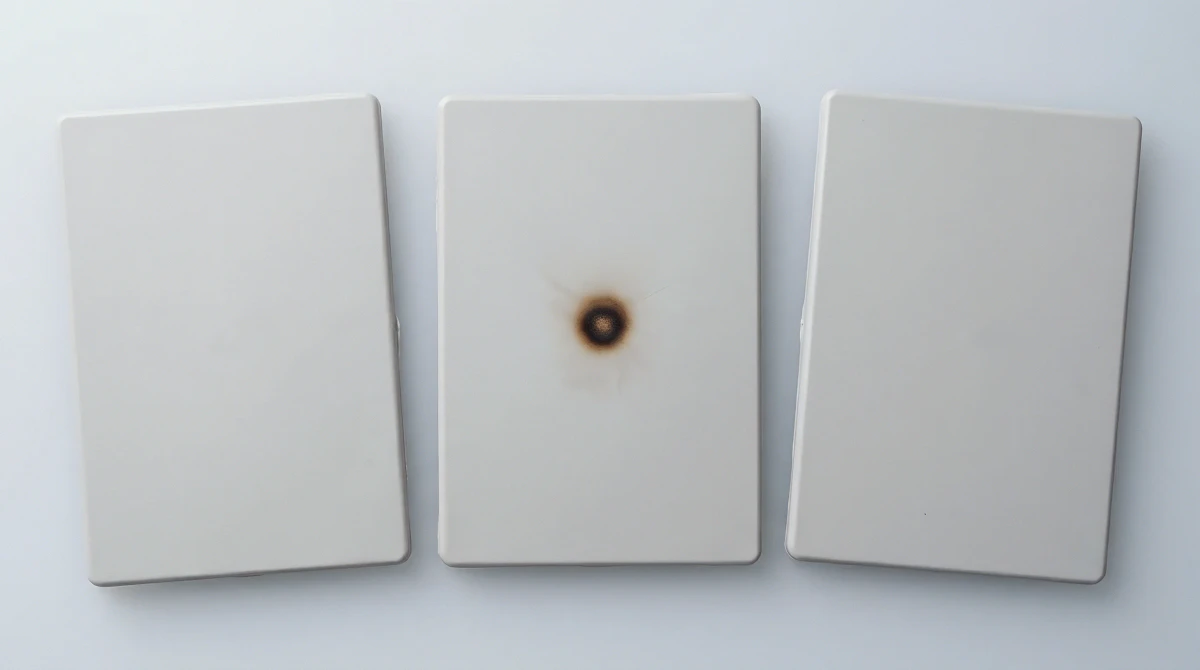
The glow wire flammability index read for a buyer: what IEC 60695-2-12 measures, how makers print it by thickness, and what a molded part's file can carry from it.

What IEC 60695-2-12 MeasuresThe scope, printed on the IEC webstore and in the 2021 preview, is short. The standard specifies the details of the glow wire test applied to specimens of solid electrical insulating materials, or other solid materials, to determine the glow wire flammability index, GWFI.

Drying Resin and Setting Melt Temperature Before the First Injection Molded Part

Pellets are dried to a measured moisture limit, held there to the hopper, and melted inside a window that the resin maker prints.

What Dry Resin and a Correct Melt Temperature ProtectWater in a nylon melt is not a surface problem. DuPont explains that water carried into the melt triggers hydrolysis, which breaks the polymer down, costs toughness and strength, and makes the melt flow more easily.

UL 94 Flammability Ratings Explained for Molded Plastic Parts

The UL 94 classes read as a buyer needs them: what each test does, how three common resin sheets print a rating, and what a supplier should show.

What UL 94 Measures and What It Is NotUL 94 is a family of small-scale flame tests on strips and plaques of plastic, run under laboratory conditions. UL's own page on combustion tests for plastics groups the classifications into twelve: HB, V-0, V-1 and V-2, 5VA and 5VB, VTM-0, VTM-1 and VTM-2, and HF-1, HF-2 and HBF for foams.

Glass-Filled Nylon 66 in Injection Molding and What It Does to an Aluminum Tool

How a glass-reinforced nylon behaves dry and conditioned, in the press and on an aluminum tool, and what its datasheet leaves for the buyer to settle.

Properties of 30 Percent Glass-Filled Nylon 66 Dry and ConditionedPA66 with 30 percent glass is one of the most common reinforced engineering grades, and BASF's Ultramid A3WG6 LT BK, a laser-transparent black grade whose sheet is dated 09/2026, is a clear example of how the family reads. The sheet names the polymer PA66-GF30 and gives its typical values for uncolored product at 23 °C.

Request an Injection Molding Quote

Send the 2D drawing and the 3D file, with the quantity and the stage of the project. An engineer replies within 1 working day.

The quote form, the mutual NDA and the private folder for your files are on Protolis Atelier, with Injection Molding chosen.

Request a Quote