Fill Time

Fill time is how long the screw takes to fill the cavity in the speed-controlled phase, before the press switches to pressure control.

Every Fill Time article of the Injection Molding Resources, newest first, each written from published standards, research and makers’ data.

Meaning

Fill time is how long the screw takes to fill the cavity in the speed-controlled phase, before the press switches to pressure control. It is chosen against how fast the resin freezes. Too slow and the melt starts to solidify before the cavity is full. Too fast for the gate and the melt is oversheared.

Typical Range

DuPont’s nylon guide calls 1 to 3 seconds a fast fill and wants it in thin sections. Thick sections take a slower fill. Glass-reinforced and other nucleated nylons freeze sooner and need the faster end. The Zytel 70G33HS1L window lists 1 to 3 seconds, slower for thick sections.
Read More

Effect on Surface

A quick fill gives a better surface on nucleated, glass-reinforced nylon. A slow fill leaves frosting, which is often mistaken for bad fiber dispersion or wet resin. DuPont’s advice is to change fill speed alone and look at the surface before touching the dryer or the screw.

End of Flow

For burning at the end of flow, DuPont proposes a two-stage fill. The cavity fills fast through most of its length and slower near the end. The slower last stage gives the vents more time, but it does not replace vents.

Transfer Point

Fill ends at the transfer position, as late as the process allows and never after the cavity is full. Switching earlier leaves the hold phase to finish filling at low speed. Switching later drives pressure into a full cavity and leaves a stressed zone near the gate.

Record

A first article records the fill time with the melt temperature, mold temperature and transfer position.
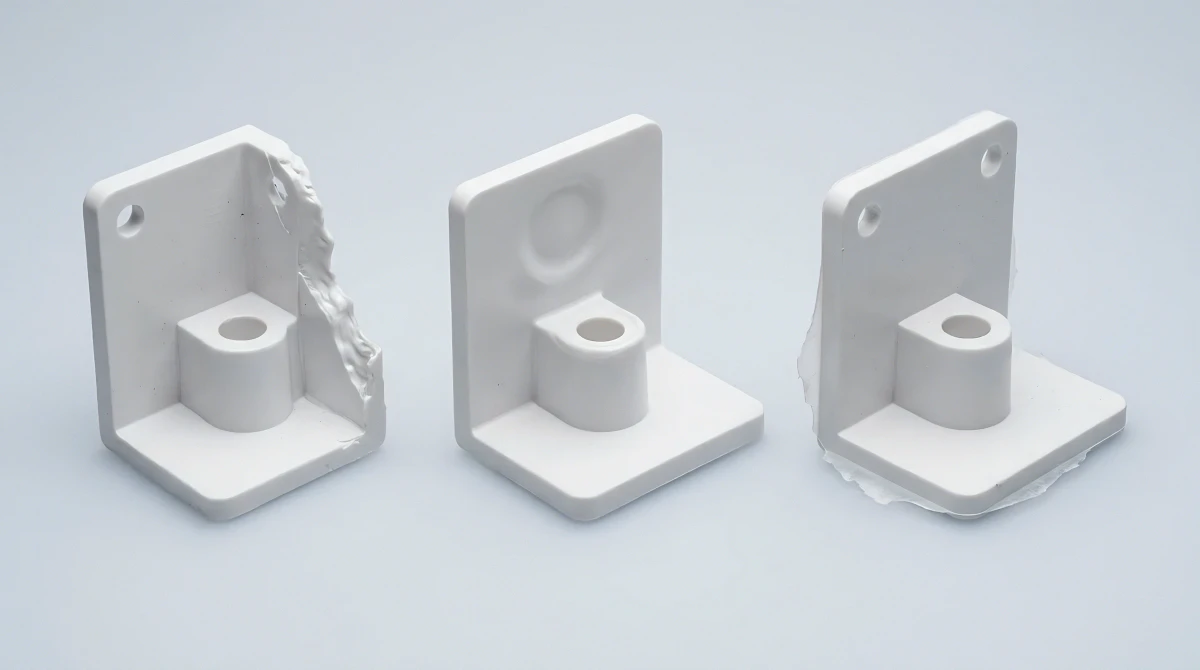
Short Shot, Sink and Flash in Injection Molding Traced to Their Cause

Short shots, sinks and flash traced to the melt volume, pressure and steel behind them, with the checks that find the cause before a setting is moved.

What Short Shots, Sink and Flash Have in CommonA short shot is a part the cavity never finished. BASF's troubleshooting brochure for engineering thermoplastics describes it as a part not completely formed, mainly in the areas furthest from the gate or in thin walls.

How to Start Up an Injection Mold and Take the First Shots

A new mold is started cold on purpose, filled in stages with short shots, and read for vents, gates and heat before any process is fixed.

The Start-Up Sequence from a Cold Barrel to the First ShotEight moves take a machine from cold to its first complete part. The first four prepare the melt, the next three shape the shot, and the last one is a decision: whether the part describes the tool or only the settings.

Glass-Filled Nylon 66 in Injection Molding and What It Does to an Aluminum Tool

How a glass-reinforced nylon behaves dry and conditioned, in the press and on an aluminum tool, and what its datasheet leaves for the buyer to settle.

Properties of 30 Percent Glass-Filled Nylon 66 Dry and ConditionedPA66 with 30 percent glass is one of the most common reinforced engineering grades, and BASF's Ultramid A3WG6 LT BK, a laser-transparent black grade whose sheet is dated 09/2026, is a clear example of how the family reads. The sheet names the polymer PA66-GF30 and gives its typical values for uncolored product at 23 °C.

Request an Injection Molding Quote

Send the 2D drawing and the 3D file, with the quantity and the stage of the project. An engineer replies within 1 working day.

The quote form, the mutual NDA and the private folder for your files are on Protolis Atelier, with Injection Molding chosen.

Request a Quote