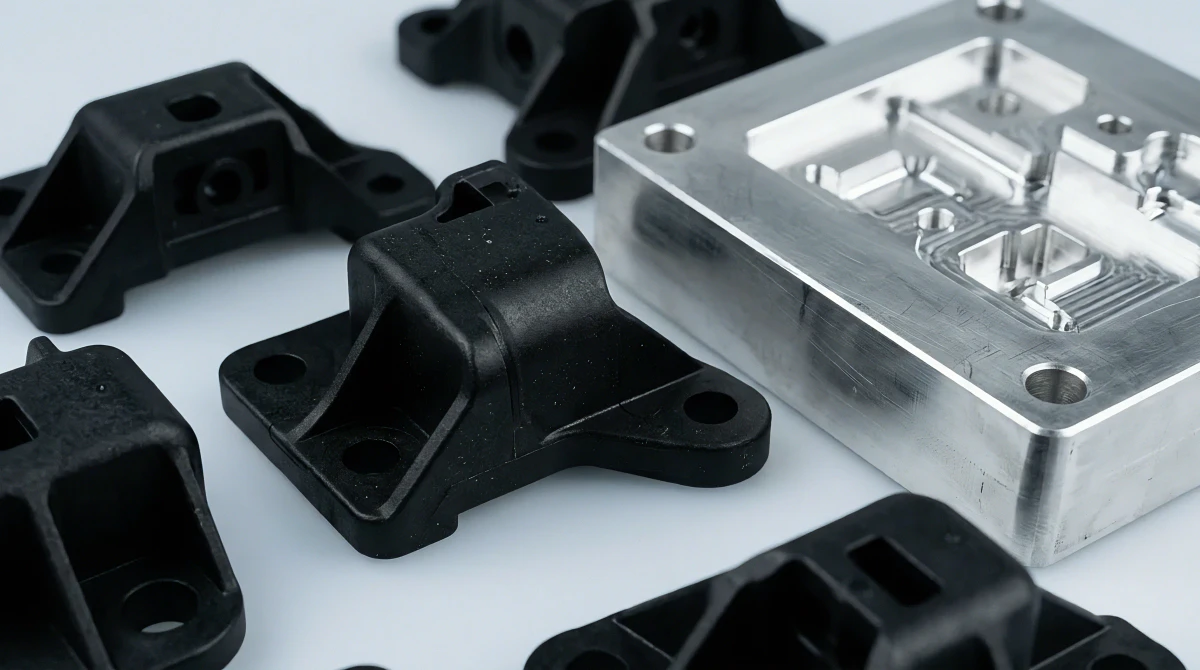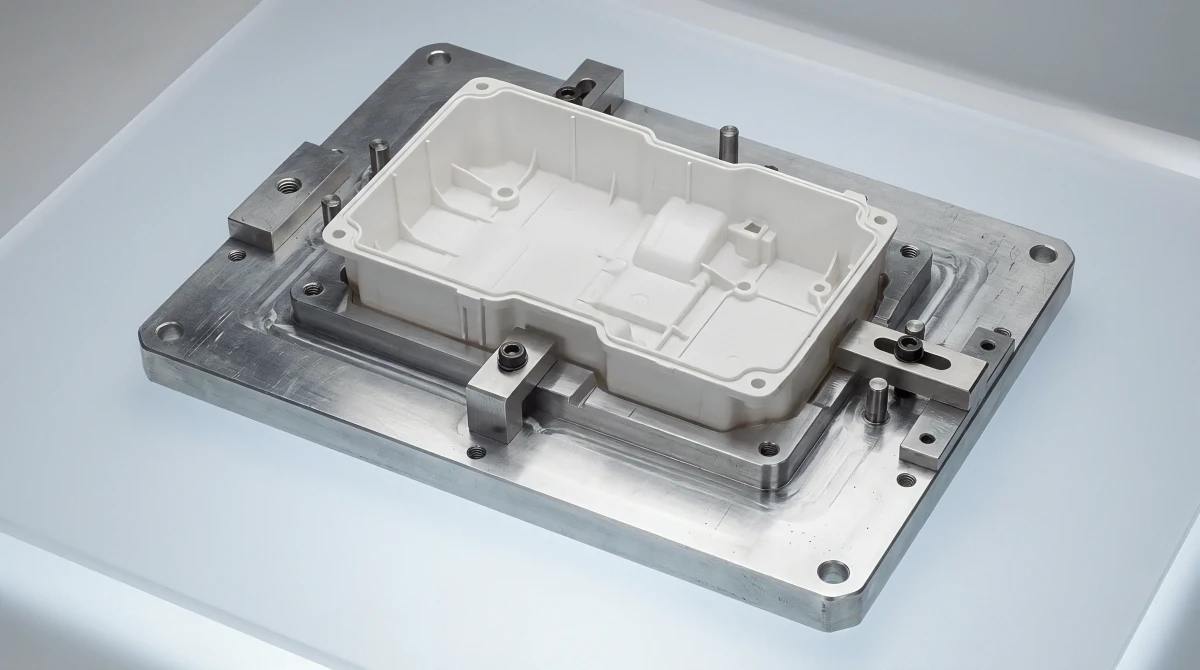
Glass-Filled Nylon 66

Glass-filled nylon 66 is nylon 66 reinforced with glass fiber, 33 percent in the grade read here, for a stiff part that shrinks by direction.

Every Glass-Filled Nylon 66 article of the Injection Molding Resources, newest first, each written from published standards, research and makers’ data.

Meaning

Glass-filled nylon 66 is nylon 66 reinforced with glass fiber, 33 percent in the grade read here, for a stiff part that shrinks by direction. Zytel 70G33HS1L is the heat-stabilized grade read in these resources. Its fibers line up with the melt flow. That alignment sets most of how the part behaves at the gauge.

Shrinkage by Direction

The grade prints 0.30 percent shrinkage along the flow and 1.1 percent across it under ISO 294-4. The ratio of nearly four to one explains why glass nylon warps. On 100 mm (3.94 in) the two directions differ by 0.8 mm before any wall variation. The cavity is cut 100.30 mm along the flow and 101.11 mm across it.
Read More

Expansion by Direction

The general coefficients are 1.8E-5 per °C along the flow and 8.3E-5 per °C across it. Across the flow the coefficient rises from 6.5E-5 below 23 °C to 1.4E-4 between 55 and 160 °C. Over a rise of 105 °C a 100 mm width grows 1.47 mm across the flow and 0.14 mm along it. A part with one fixed clearance on both axes has used one number where the part has two.

Dry and Conditioned

Tensile modulus reads 11,000 MPa (1.60 million psi) dry and 8,000 MPa (1.16 million psi) conditioned. The grade takes up 1.8 percent water at equilibrium at 23 °C and 50 percent relative humidity. The glass transition at 80 °C (176 °F) lies between room and service temperature for many parts.

Molding

The melt runs at 285 to 305 °C (545 to 581 °F). The mold runs at 70 to 120 °C (158 to 248 °F), with 100 °C (212 °F) as the optimum. Hold pressure is 50 to 100 MPa for 3 seconds per millimeter of wall. Screw speed is capped at 12 m/min (472 in/min), because high screw speeds break fibers.

Datum and Gate

On a flat cover gated at one end, a datum on the long edge reads the far side across the 1.1 percent direction. A datum on the gated end swaps the roles. The gate location and the datum system are fixed before the first sample.

How Temperature Changes the Size of a Molded Plastic Part at the Gauge

How coefficients of expansion turn a few degrees of gauge temperature into hundredths of a millimeter, by resin and direction, and what a drawing should state.

Linear Thermal Expansion of Polycarbonate, Glass-Filled Nylon and AcetalLinear thermal expansion is reported on datasheets as a coefficient, the length change per unit length per degree. The three makers print it by the ISO or TMA method, and they differ in how finely they split it.
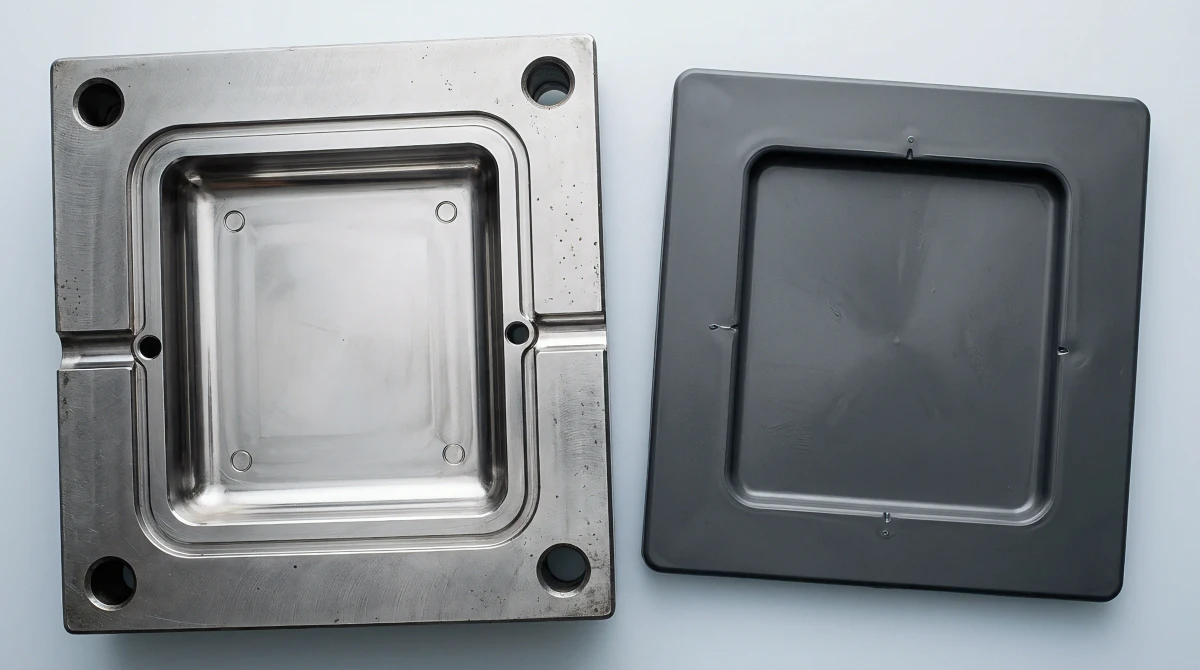
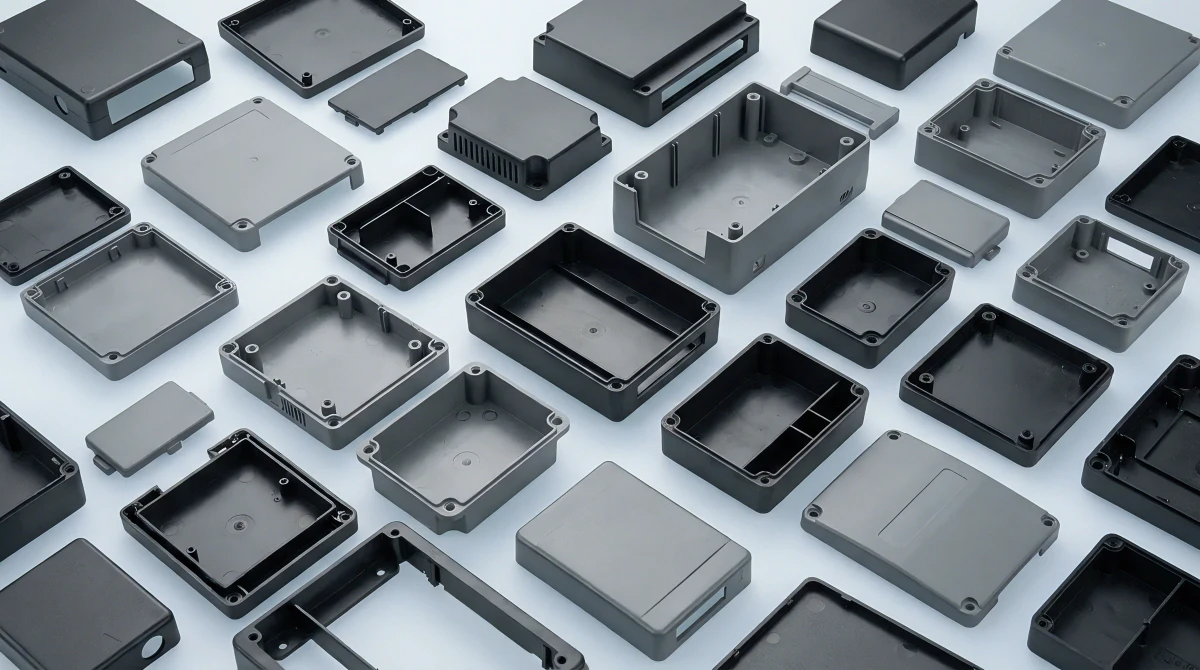
Injection Molding Shrinkage Along and Across the Flow by Material

Molding shrinkage read by direction and condition for three resins, with the process settings that move it and the way a first sample turns it into a cavity allowance.

Shrinkage of Polycarbonate, Glass-Filled Nylon 66 and Acetal Along and Across the FlowISO 294-4:2018 sets out the method for measuring mold shrinkage and post-mold shrinkage of injection molded thermoplastic test specimens, parallel and normal to the direction of melt flow. Resin makers print the result in two lines, one per direction.

ISO 20457 Tolerances for Plastic Molded Parts Read for the Buyer

How ISO 20457 is worded for plastic molded parts, what a supplier signs when a drawing cites it, and which items stay outside it for the order to settle.

What ISO 20457 Covers for Injection Molded PartsAccording to the abstract published by the Swedish Institute for Standards (SIS), ISO 20457 specifies possible manufacturing tolerances for plastic moulded parts, and it covers all integral features with general tolerances, using a surface profile tolerance within a specified datum system. It applies to injection moulding, injection compression moulding, transfer moulding, compression moulding and rotational moulding of non-porous parts in thermoplastics, thermoplastic elastomers and thermosets.

Glass-Filled Nylon 66 in Injection Molding and What It Does to an Aluminum Tool

How a glass-reinforced nylon behaves dry and conditioned, in the press and on an aluminum tool, and what its datasheet leaves for the buyer to settle.

Properties of 30 Percent Glass-Filled Nylon 66 Dry and ConditionedPA66 with 30 percent glass is one of the most common reinforced engineering grades, and BASF's Ultramid A3WG6 LT BK, a laser-transparent black grade whose sheet is dated 09/2026, is a clear example of how the family reads. The sheet names the polymer PA66-GF30 and gives its typical values for uncolored product at 23 °C.

Request an Injection Molding Quote

Send the 2D drawing and the 3D file, with the quantity and the stage of the project. An engineer replies within 1 working day.

The quote form, the mutual NDA and the private folder for your files are on Protolis Atelier, with Injection Molding chosen.

Request a Quote