Cooling Time

Cooling time is the time a part stays in the closed mold after the hold phase, until it is stiff enough to eject.

Every Cooling Time article of the Injection Molding Resources, newest first, each written from published standards, research and makers’ data.

Meaning

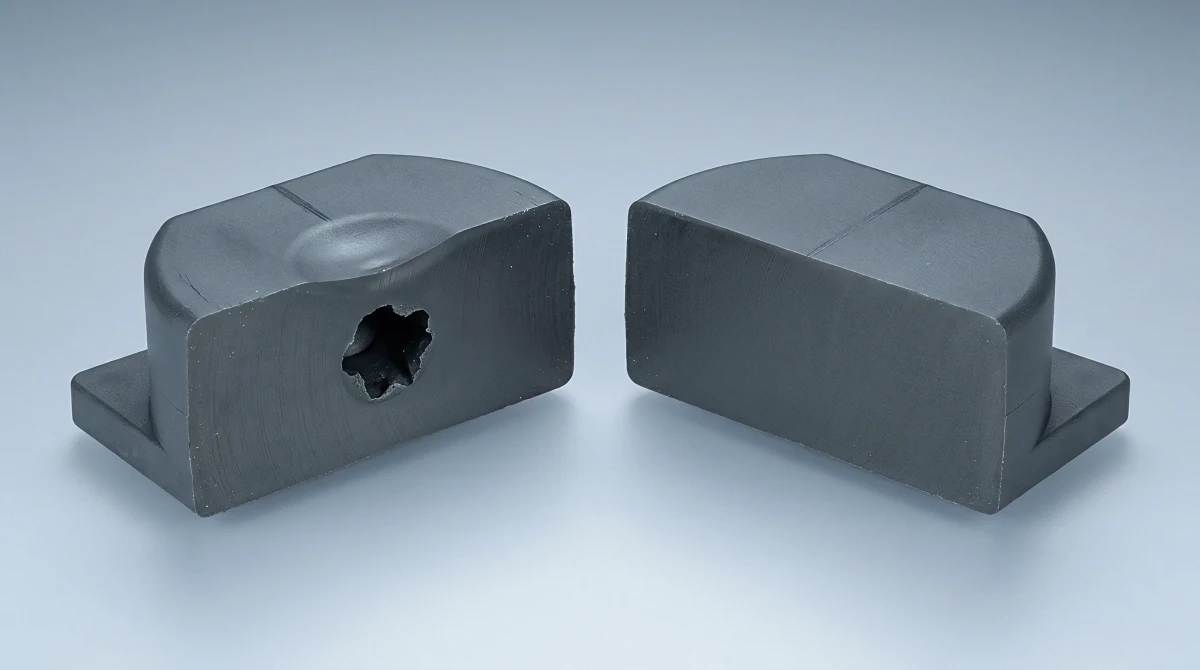
Cooling time is the time a part stays in the closed mold after the hold phase, until it is stiff enough to eject. For most parts it is the largest block of the cycle. Wall thickness sets most of it, because plastic conducts heat poorly. A crystalline resin may need almost none of it.

Controlling Factors

Heat has to travel from the middle of the wall to the cavity surface. Thick parts cool far more slowly than thin ones, according to DuPont. The tool metal sets how fast heat leaves the surface. Aluminum conducts 4 to 5 times as well as P-20 steel. The heat still has to cross the plastic wall, so the gain is not guaranteed.
Read More

Calculation

K. A. Stelson’s paper in the Proceedings of the Institution of Mechanical Engineers reviews the published cooling-time formulae. It finds that many contain errors that were accepted for decades. Ejection can be judged on mid-plane or average temperature, and thin and thick parts deviate from the theory. A formula is a starting point, and the press gives the final number.

Acetal Case

DuPont’s acetal trials show cooling time doing harm. With 15 seconds of packing, 2 seconds of cooling held the diameter to ±0.02 mm. With 15 seconds of cooling, the spread widened to ±0.07 mm and the cycle grew from 26 to 41 seconds. Once packed, acetal is solid, and DuPont ejects it hot to cool in air.

Record

A cycle total says little without the pack and cooling times behind it. A first article records the cooling time and how long after ejection the parts were measured. Cooling time is re-measured when the cavity material or the cooling circuit changes.

Gate Location and Gate Freeze in Injection Molding

Where a gate goes, how big it is and how long it stays open, with the weight study that sets hold time from the gate itself.

How Gate Location and Gate Freeze Shape a Molded PartAutodesk's Moldflow design rules open with the claim that gate position strongly affects material orientation and warpage, and that changing the gate is sometimes the only way to control orientation. Every gate injects under the same pressure, and the aim of gating is to avoid overpacking some paths while others are still filling, because unequal packing gives unequal shrinkage.
Cycle Time and Parts per Hour in a Bridge Injection Molding Run

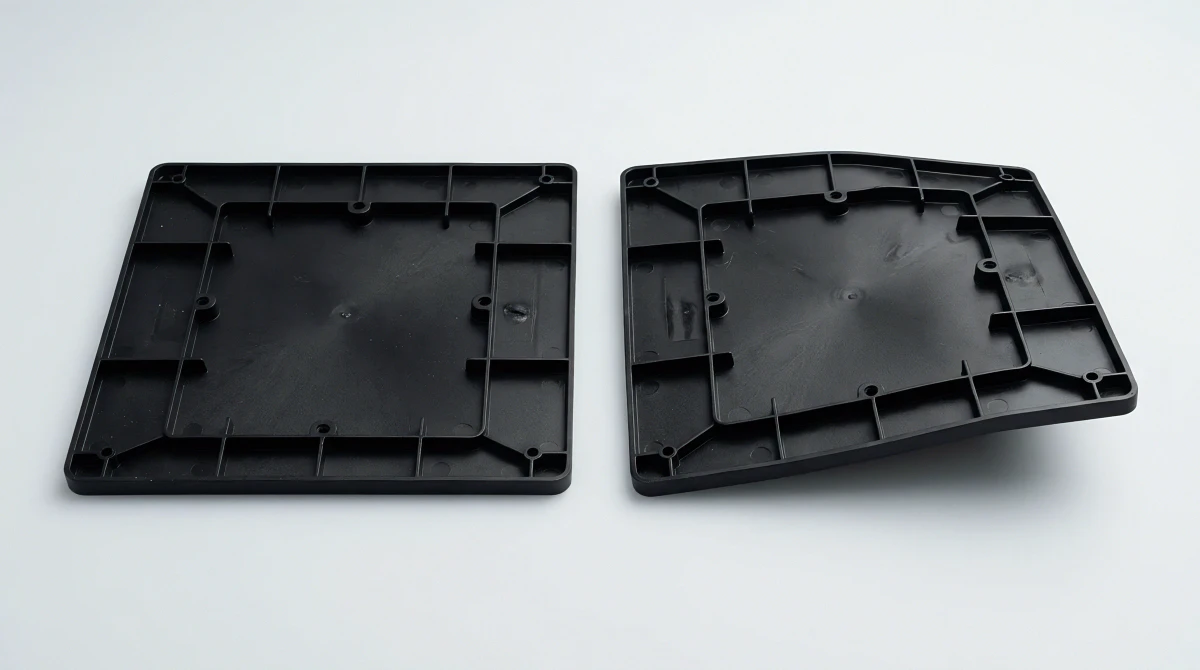
A cycle is the sum of fill, hold, cooling and press motions, and a supplier's number is only as good as the pack and cooling times behind it.

What Sets Cycle Time and Parts per HourA molding cycle is a loop of seven moves: the mold closes, the cavity fills, the pack and hold phase runs, the part cools, the mold opens, the part is ejected, and the screw recovers for the next shot. Recovery runs while the part cools, which is why DuPont's nylon guide asks for screw speeds adjusted so that screw retraction time is shorter than the cooling phase.

How Tightly Acetal Parts Hold Dimension in Injection Molding

Acetal dimension spread measured on one part under four press settings, with the gate and cooling rules behind it and a tolerance budget for a 50 mm feature.

Outer Diameter Spread Under Four Packing and Cooling SettingsThe test part in DuPont's tips is a tribological sample used for wear and friction testing, a part whose outer diameter has to be as dimensionally precise as possible. DuPont molded it under four settings, measured the outer diameter and reported the mean with its variation.

Request an Injection Molding Quote

Send the 2D drawing and the 3D file, with the quantity and the stage of the project. An engineer replies within 1 working day.

The quote form, the mutual NDA and the private folder for your files are on Protolis Atelier, with Injection Molding chosen.

Request a Quote