ISO 294-4

ISO 294-4 is the ISO method for measuring mold shrinkage and post-mold shrinkage of injection-molded thermoplastic specimens, parallel and normal to the melt flow.

Every ISO 294-4 article of the Injection Molding Resources, newest first, each written from published standards, research and makers’ data.

Meaning

ISO 294-4 is the ISO method for measuring mold shrinkage and post-mold shrinkage of injection-molded thermoplastic specimens, parallel and normal to the melt flow. Resin makers print its result as two lines, one per direction. The current text is edition 3, published in December 2018 by ISO/TC 61/SC 9 and confirmed in 2024. Its value is the starting estimate for a cavity allowance.

Scope

The standard’s abstract defines mold shrinkage as free shrinkage, the maximum value of any restricted shrinkage. A long clear span on a real part shrinks close to it. A feature held between walls shrinks less. The abstract also excludes humidity, which belongs to post-mold and total shrinkage.
Read More

Printed Pairs

Delrin 500P acetal prints 2.0 percent along the flow and 1.9 percent across it. Zytel 70G33HS1L glass nylon prints 0.30 and 1.1 percent. Makrolon 2407 polycarbonate prints 0.65 and 0.70 percent, measured on a 60 by 60 by 2 mm plaque at 500 bar. On a 100 mm (3.94 in) dimension these become 2.0, 0.30 and 0.65 mm along the flow.

Direction Gap

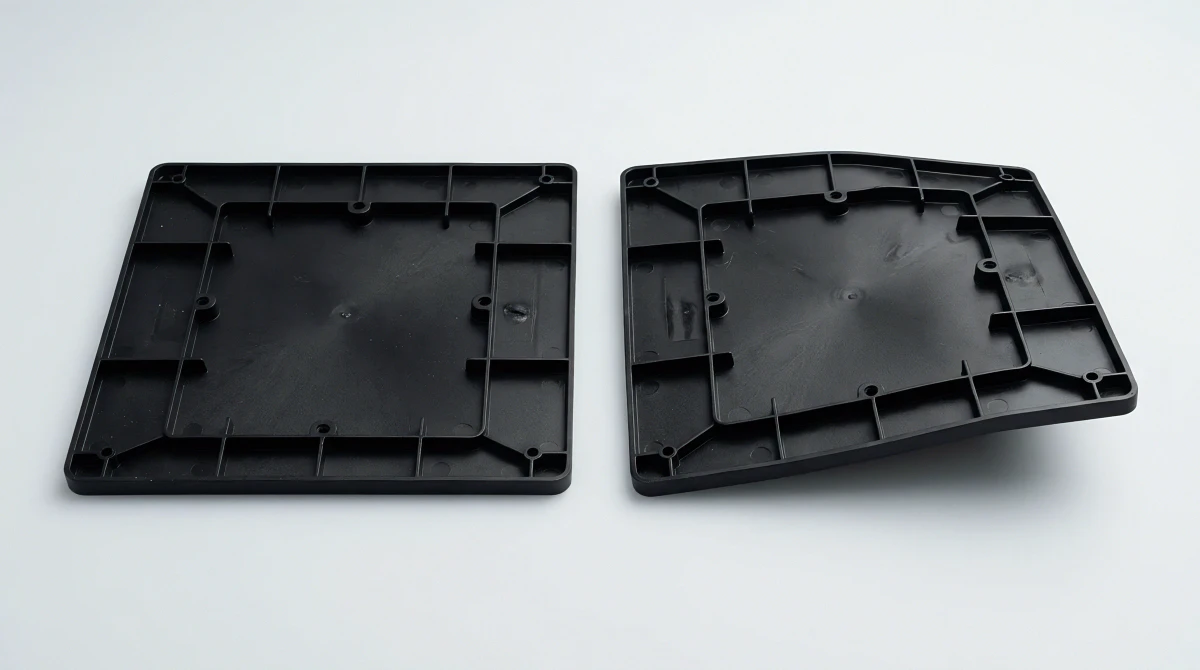
A small gap between the two lines keeps the part’s shape, and a large gap changes it. Glass nylon’s gap of 0.8 points makes a square plate not square unless the cavity was cut with two allowances. None of these numbers is a tolerance. They are central values from a test plaque, and a part’s shrinkage differs with its thickness, gate and process.

Application

A toolmaker starts the allowance from the printed pair. The cavity is then corrected to what the first samples measure.

ABS and PC/ABS Blends in Injection Molding

ABS and PC/ABS read from the makers' datasheets: drying, processing windows, shrinkage, snap-fit strain, impact and when the blend earns its stricter dryer.

How ABS and PC/ABS Differ in Injection MoldingABS is a terpolymer, and Moldflow's material page describes its structure: a continuous phase of styrene-acrylonitrile with a dispersed phase of polybutadiene rubber. Acrylonitrile brings hardness and chemical and heat resistance, styrene brings processability, gloss and strength, and butadiene brings toughness and impact strength.

Injection Molding Shrinkage Along and Across the Flow by Material

Molding shrinkage read by direction and condition for three resins, with the process settings that move it and the way a first sample turns it into a cavity allowance.

Shrinkage of Polycarbonate, Glass-Filled Nylon 66 and Acetal Along and Across the FlowISO 294-4:2018 sets out the method for measuring mold shrinkage and post-mold shrinkage of injection molded thermoplastic test specimens, parallel and normal to the direction of melt flow. Resin makers print the result in two lines, one per direction.

ISO 20457 Tolerances for Plastic Molded Parts Read for the Buyer

How ISO 20457 is worded for plastic molded parts, what a supplier signs when a drawing cites it, and which items stay outside it for the order to settle.

What ISO 20457 Covers for Injection Molded PartsAccording to the abstract published by the Swedish Institute for Standards (SIS), ISO 20457 specifies possible manufacturing tolerances for plastic moulded parts, and it covers all integral features with general tolerances, using a surface profile tolerance within a specified datum system. It applies to injection moulding, injection compression moulding, transfer moulding, compression moulding and rotational moulding of non-porous parts in thermoplastics, thermoplastic elastomers and thermosets.

Glass-Filled Nylon 66 in Injection Molding and What It Does to an Aluminum Tool

How a glass-reinforced nylon behaves dry and conditioned, in the press and on an aluminum tool, and what its datasheet leaves for the buyer to settle.

Properties of 30 Percent Glass-Filled Nylon 66 Dry and ConditionedPA66 with 30 percent glass is one of the most common reinforced engineering grades, and BASF's Ultramid A3WG6 LT BK, a laser-transparent black grade whose sheet is dated 09/2026, is a clear example of how the family reads. The sheet names the polymer PA66-GF30 and gives its typical values for uncolored product at 23 °C.

Acetal Homopolymer Injection Molding Properties and Gate Rules

Delrin 500P read from the maker's sheet and molding tips: why acetal shrinks and needs a packed gate, how hot the melt may run, and what to check on an aluminum tool.

Delrin 500P Properties in Metric and Inch UnitsDelrin 500P NC010 is a medium-viscosity acetal homopolymer, and Delrin prints its ISO values as the reference beside 500CPE on its own product data sheet. The grade has a melt mass-flow rate of 15 g/10 min at 190 °C and 2.16 kg under ISO 1133.

Request an Injection Molding Quote

Send the 2D drawing and the 3D file, with the quantity and the stage of the project. An engineer replies within 1 working day.

The quote form, the mutual NDA and the private folder for your files are on Protolis Atelier, with Injection Molding chosen.

Request a Quote